Psychology Today profile tips for better-fit therapy inquiries
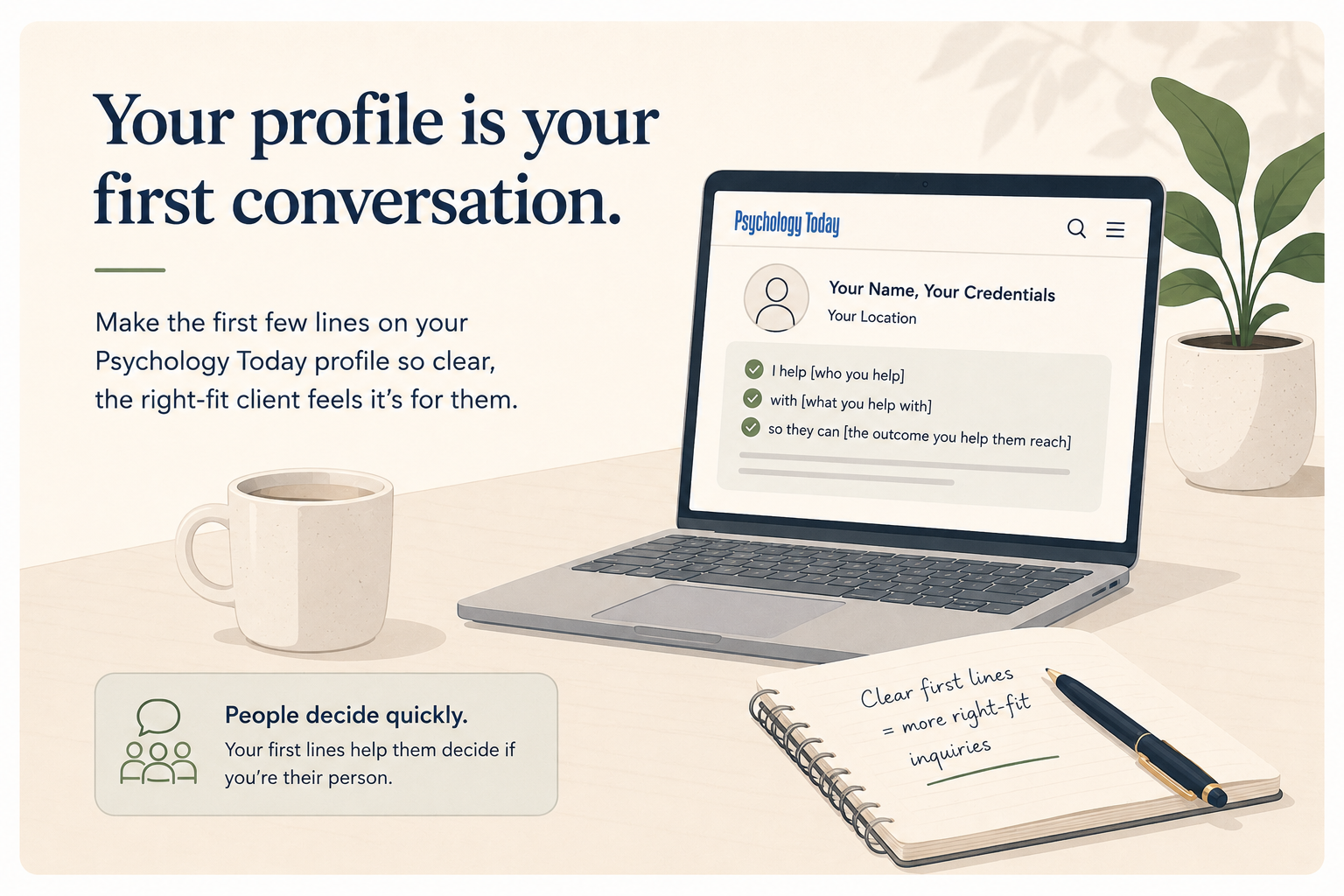
Getting Psychology Today inquiries that are not quite the right fit?
It is easy to blame the directory when messages feel random, low-quality, or inconsistent. Sometimes the platform is part of the issue. But sometimes the first few lines of the profile are doing more damage than the practice owner realizes.
Many therapy practice owners were trained to be clinicians, not directory copywriters, intake designers, or growth strategists. That matters because Psychology Today is not a quiet corner of the internet. Psychology Today’s 2026 media kit lists 21.4 million unique visitors per month and 350,000+ therapists and treatment centers.
When a directory is that large and crowded, the first few lines of a profile have to do more than sound warm. They have to help a potential client understand quickly whether your profile is relevant to them.
So if your Psychology Today profile sounds warm but still brings the wrong inquiries, that does not mean you failed. It may mean the profile is asking a potential client to do too much guessing.
Your Psychology Today profile may not need a full rewrite. It may need a clearer first three lines.
The problem
The profile may be warm, but still too broad.
Many Psychology Today profiles start with some version of this:
“I provide a warm, supportive, nonjudgmental space for individuals navigating anxiety, depression, trauma, relationships, and life transitions.”
There is nothing wrong with that sentence clinically. It sounds caring. It sounds safe. It sounds professional.
But from a new client’s point of view, it may not answer the questions they are quietly asking:
- Is this therapist for someone like me?
- Do they understand what I am dealing with?
- Are they available in a way that works for me?
- What happens if I reach out?
When those questions are unanswered, two things can happen.
Some right-fit clients leave because they cannot tell whether the profile fits their situation. Other people reach out even though they are not a good fit, because the profile sounds broad enough to cover almost anything.
That is how a profile can create both fewer inquiries and more poor-fit inquiries at the same time.
This is different from the broader question of whether the directory is still working. We covered that in Is Psychology Today still working for therapists? This article is more practical and narrower: before changing platforms, rewrite the opening so your profile has a better chance of helping right-fit clients recognize themselves.
The tip
Rewrite the first three lines of the profile.
Start with the first three lines of your Psychology Today profile.
Not the whole profile. Not every specialty. Not every sentence. Just the opening.
The first few lines have one simple job: help the right person quickly understand who you help, what good fit looks like, and what step they should take next.
Use this three-line profile formula
- Line 1: Name the person or situation you help in plain English.
- Line 2: Describe what good fit looks like in real life.
- Line 3: Give a clear next step, including availability or intake details if they are accurate.
This does not mean making the profile narrow just to sound niche. It means being clearer about who is most likely to benefit from reaching out.
A profile can still be compassionate and clinically grounded while being more specific.
The goal is not to sound more impressive. The goal is to help the right person recognize themselves faster.
Before and after
A clearer Psychology Today opening.
Here is what this can look like in practice.
I provide a warm and compassionate space for adults dealing with anxiety, depression, stress, trauma, relationships, and life transitions. My approach is collaborative and client-centered. I believe therapy can help you heal and grow.
I help anxious, high-achieving adults who look like they are holding everything together but feel tense, overwhelmed, or stuck in overthinking. Many clients come to me when work stress, people-pleasing, sleep problems, or relationship strain are becoming hard to ignore. If this sounds familiar, you can message me here to ask about fit and current openings.
The second version is not louder. It is clearer.
It does not claim to help everyone. It does not list every possible diagnosis. It gives a right-fit client a more recognizable picture.
Someone reading it can think, “That sounds like me,” or “That does not sound like me.” Both outcomes are useful.
That is the point of better profile language. It should not only increase interest. It should also help reduce avoidable mismatch.
For group practices
Make the profile fit the clinician.
This matters even more in a group practice.
Many group practice profiles sound like the practice owner wrote one general description and reused it across several clinicians. The result is that every profile sounds caring, trained, and flexible, but none of them help clients choose.
That can create extra intake work. The admin team has to interpret vague inquiries, explain clinician differences, and match people manually. The owner may get pulled into decisions that the profile could have made easier.
A clearer opening can help each clinician’s profile answer a different fit question.
I work with teens and adults experiencing anxiety, depression, trauma, grief, relationship issues, and life transitions. I offer a supportive space to explore your concerns and work toward healing.
I work with college students and young adults who feel anxious, disconnected, or unsure how to handle the next stage of life. Clients often come to me when school pressure, family expectations, identity questions, or relationship stress are becoming too heavy to manage alone. I currently offer weekday telehealth sessions, and our intake team can help you decide whether I may be a good fit.
Notice how the second version helps the client and the intake team.
It gives the potential client language for their situation. It gives the admin team a clearer matching signal. It also reduces the chance that every clinician profile feels interchangeable.
If your practice is trying to fill newer clinicians, this is especially important. A new clinician does not always need a louder profile. They may need a clearer reason why a right-fit client would choose them.
Logistics
Where availability belongs.
If availability is part of the confusion, name it carefully.
For example
- “I currently have daytime telehealth openings.”
- “Our intake team can help you find the best current clinician match.”
- “I am accepting new clients for online sessions on Tuesdays and Thursdays.”
Only include availability language if it is true and easy to keep updated. Outdated availability can create frustration quickly, especially on directories where clients are comparing several options.
You do not need to include every scheduling detail in the first three lines. But if your practice keeps getting inquiries for times, locations, insurance plans, or services you do not offer, that is a sign the profile may need clearer logistics.
This is also where inquiry quality and profile clarity connect. If you are not sure how much mismatch is happening, try tracking your poor-fit inquiry rate for 30 days before changing everything.
The next step
Connect the profile to the intake path.
A Psychology Today profile should not feel separate from the rest of your intake process.
If the profile says “reach out for a consultation,” the first response should explain how that consultation works.
If the profile says “our intake team can help you find the right clinician,” the website and response message should support that.
If the profile sends people to your website, the website should make fees, insurance, services, clinician fit, and next steps easier to understand.
This is where many practice owners lose right-fit clients. The profile may create interest, but the next step creates hesitation.
That is why directory work should not sit in a silo. It belongs inside the broader growth path from visibility to inquiry to intake. For a bigger-picture view, read Private practice marketing: a practical growth system for therapists or How to get more therapy clients without random marketing.
Quick check
What is missing from your first three lines?
Open one Psychology Today profile and read only the first three lines.
Then ask:
- Can a right-fit client tell this profile is for someone like them?
- Does the profile describe a real-life situation, not just a list of clinical terms?
- Does it explain what good fit looks like?
- Does it give a clear next step?
- If availability matters, is it current and easy to understand?
Choose one missing piece and fix that first.
A simple rewrite
A prompt you can use this week.
Try this prompt:
Profile rewrite prompt
I help [specific client or situation] who are dealing with [plain-English problem]. Clients often come to me when [real-life signs this is affecting them]. If this sounds familiar, [clear next step that matches your intake process].
Here are a few examples:
For couples therapy
I help couples who are tired of having the same argument and still feeling misunderstood. Many couples come to me when communication feels tense, distance is growing, or small conversations turn into bigger conflict. If you are wondering whether therapy could help, you can message me here to ask about fit and current openings.
For teen therapy
I work with teens who seem anxious, withdrawn, overwhelmed, or more reactive than usual. Parents often reach out when school stress, friendships, mood changes, or family conflict are starting to affect daily life. You can contact our intake team to ask whether I may be a good fit for your teen.
For trauma therapy
I help adults who feel stuck in patterns of alertness, shutdown, guilt, or disconnection after difficult experiences. Clients often come to me when they are functioning on the outside but feel exhausted by what they are carrying. If you are looking for trauma-informed therapy, you can message me to ask about current availability.
These are not perfect templates. They are starting points. The best version should sound like your practice, match your actual services, and stay within your clinical and ethical boundaries.
Better profile language does one thing better than a generic opening: it reduces guessing.
The takeaway
Start smaller than a full profile rewrite.
If Psychology Today is sending poor-fit inquiries, the answer is not always to cancel the profile, join another directory, or rewrite every word.
Start smaller.
Rewrite the first three lines so they name who you help, what fit looks like, and what happens next.
Then watch what changes. Are the inquiries clearer? Are fewer people asking about services you do not offer? Are more right-fit clients reaching out with a better understanding of your practice?
That is a more useful question than “Is Psychology Today good or bad?”
The better question is: is this profile helping the right person take the next clear step?
Want a faster way to check your profile?
Use the free Psychology Today Profile Optimizer to review your opening, right-fit client language, logistics, and next step before rewriting everything.
