Is Psychology Today still working for therapists? What lower views and referrals may really mean
Many therapists are asking some version of the same question: is Psychology Today still working?
For some practices, the concern is obvious.
Profile views are down. Contacts are down. A profile that used to produce a few steady inquiries each month now feels quiet. In therapist groups, practice owner conversations, and marketing discussions, more people seem to be wondering whether Psychology Today changed, whether clients are searching differently, or whether the directory has simply become too crowded.
The answer is not as simple as “Psychology Today is dead.”
That framing is too broad. It also leads practice owners to make rushed decisions: canceling the profile, rewriting everything, adding another directory, or assuming they need more marketing before they know what actually changed.
Psychology Today may still have massive reach. That does not mean every therapist is getting the same value from it.
The market-level picture
Psychology Today may still have traffic. That does not mean your profile is getting enough of it.
The first mistake is treating “Psychology Today traffic” as one simple number.
There are several different questions hiding inside the traffic conversation:
| Question | Why it matters |
|---|---|
| Is Psychology Today’s total website traffic up or down? | This tells us whether the platform still has broad reach. |
| Is organic search traffic still sending people to the directory? | This tells us whether Google is still a major entry point. |
| Are more therapists, groups, treatment centers, and platforms listed? | This tells us whether competition for visibility is increasing. |
| Are your own result views, profile views, website clicks, and contacts down? | This tells us whether the platform is still working for your practice. |
Those are not the same question.
A therapist can lose inquiries even if Psychology Today still has millions of visitors. A group practice can see fewer contacts even if the directory itself remains strong. A profile can show up in search results but lose clicks because the listings around it are more specific, more current, more relevant, or better aligned with what the client is filtering for.
Helpful context
Psychology Today’s 2026 media kit lists 21.4 million unique visitors per month, 52 million page views per month, 350,000+ therapists and treatment centers, and more than a million referrals per year.
Those numbers are large. They also create a practical question for practice owners:
If the number of listed providers grows faster than the number of right-fit referral opportunities, what happens to the average profile?
The answer is simple: the directory can still be valuable while each individual profile has to work harder to earn attention.
That is why the better question is not only:
Is Psychology Today still getting traffic?
The better question is:
Is your practice still getting enough of the attention available there?
The supply-and-demand problem
The directory may still be strong, but the marketplace around each profile has changed.
Think of Psychology Today as a marketplace.
On one side is demand:
People searching for therapy, clicking profiles, comparing options, and sending inquiries.
On the other side is supply:
Therapists, group practices, treatment centers, psychiatrists, online clinicians, insurance-based providers, private-pay specialists, large therapy platforms, and profiles managed at scale.
If demand grows and supply stays stable, each provider may get more opportunity.
If supply grows faster than demand, each provider may get less opportunity.
If supply grows while client search behavior becomes more fragmented, each provider may feel the drop even more sharply.
The simple version
More profiles + more filters + more platforms + more comparison behavior = less guaranteed attention per profile.
This is the part many practice owners feel before they can name it.
It may not be that your profile suddenly became bad.
It may not be that clients disappeared.
It may be that the marketplace became more crowded, while the path from “client is searching” to “client contacts you” became less direct.
That matters because most therapy practices are not trying to win the internet. They are trying to fill a few openings with right-fit clients.
For a solo clinician, one or two good clients from Psychology Today each month may be enough.
For a group practice trying to fill five clinicians, Psychology Today may need to produce a much more consistent flow to matter.
That is why the same directory can feel “worth it” to one clinician and almost useless to another.
A confusing reality
A mental health shortage and a crowded directory can both be true.
This is one of the most important things practice owners need to understand.
On paper, mental health demand is high.
Market context
HRSA’s 2025 behavioral health workforce brief reports that 40% of the U.S. population, or 137 million people, lived in a Mental Health Professional Shortage Area as of December 2, 2025.
So a practice owner may reasonably wonder:
If demand is so high, why are my inquiries down?
The answer is that mental health need is not the same as right-fit demand for your practice.
A person may need therapy but not be able to afford your fee.
They may need care but only search through their insurance portal.
They may need care but want immediate availability.
They may need care but be looking for in-person sessions while you are telehealth-only, or the reverse.
They may need care but prefer a platform that verifies benefits, shows appointment times, or lets them request care without calling.
They may need care but stop searching after seeing too many options.
They may need care but never make it from “thinking about therapy” to “contacting a therapist.”
High need in the market does not automatically create steady inquiries for every practice.
Need has to pass through affordability, access, timing, trust, fit, search behavior, and follow-up before it becomes a scheduled client.
This is why a practice can exist in a high-need market and still have empty clinical hours.
It is also why a national shortage can exist at the same time as a crowded directory.
A shortage means there are not enough accessible providers for the population’s need.
A crowded directory means many providers are competing for visibility in the same searchable spaces.
Those are different problems.
There may be too few Medicaid-accepting providers, too few child therapists, too few eating disorder specialists, too few clinicians with evening availability, too few rural providers, and too few therapists with immediate openings.
At the same time, a client searching “anxiety therapist near me” in a large metro area may see hundreds or thousands of options.
That creates a strange experience for both sides.
Clients feel like there are too many profiles to sort through.
Therapists feel like there are not enough inquiries.
And both can be right.
What may be happening
Why therapists may be seeing fewer Psychology Today referrals.
There is probably not one single reason.
More likely, several forces are happening at the same time.
1. The directory is more crowded.
The most obvious issue is competition.
If more clinicians, group practices, treatment centers, online clinicians, and platform-managed profiles appear in the same search results, each individual profile has to work harder to earn attention.
This matters especially in dense markets.
A therapist in Los Angeles, New York, Chicago, Austin, Denver, Seattle, Washington DC, or another competitive metro may not be competing with twenty therapists.
They may be competing with hundreds.
A private-pay group practice may be competing with solo clinicians, insurance-based providers, large therapy platforms, telehealth options, treatment centers, multi-state providers, clinicians with multiple locations, and group practices with many profiles.
That creates two separate problems.
First, a visibility problem: do clients even see your profile?
Second, a differentiation problem: when they see it, do they know why they should click?
Many therapy profiles answer the first question poorly and the second question even more poorly.
They exist, but they do not stand out.
2. Search results may be distributed differently.
A directory does not have to lose traffic for individual profiles to lose visibility.
If Psychology Today changes how it distributes search visibility, some profiles may receive fewer result views even if total directory visits remain stable.
Important nuance
ClearHealthCosts reported that Psychology Today said it periodically updates algorithms to improve consumer experience and provide more balanced choice, while also saying there had been “no overall decline in directory visits” and “no material change in total contacts.”
That distinction matters.
Total platform activity and individual profile activity can move in different directions.
In plain English:
Psychology Today can say the platform is stable while individual therapists experience real drops.
Both can be true.
The platform may still generate similar overall contacts. But those contacts may be distributed differently across profiles.
That matters for owners who built their inquiry flow around how the directory used to work.
3. Platform-managed profiles may be increasing practical competition.
Many therapists now compete not only with other independent clinicians, but also with larger platforms that can create more surface area in search results.
ClearHealthCosts has reported therapist concerns about platform-related listings and profiles connected to Alma, Grow, Headway, Rula, Octave, and other companies.
Even if there is no preferential placement, the competitive effect can still be real.
Large platforms may be able to support many profiles, cover many locations, offer insurance-based access, show more appointment availability, manage listings at scale, route clients through centralized intake, and test messaging across many clinicians.
This does not mean independent clinicians cannot compete.
But it does mean a generic profile is weaker than it used to be.
In a less crowded environment, “I help adults with anxiety and depression” may have been enough.
In a more crowded environment, that kind of profile blends in.
Client behavior changed
The old client journey is not the only journey anymore.
The old client journey may have looked like this:
Google search → Psychology Today → therapist profile → contact
That still happens.
But it is no longer the only path.
Now a client may search Google, see an AI-generated answer, scan Psychology Today, check insurance directories, ask ChatGPT what kind of therapy to look for, click several therapist websites, check Google Business Profiles, ask a friend or physician, browse Headway, Alma, Rula, Grow, Zocdoc, or another platform, return to Psychology Today later, and contact through the therapist’s website instead of PT.
That changes how practice owners should interpret the numbers.
A website click from Psychology Today may not mean “lost lead.”
It may mean “the client is still deciding.”
A person may find you on Psychology Today, click to your site, talk to a partner, return two days later, search your name on Google, and then submit a contact form.
If your intake form does not ask where they first found you, you may credit that inquiry to “website” and miss that Psychology Today helped the journey.
This is why attribution is messy.
Practice owners should not only ask:
Did they contact me through Psychology Today?
They should also ask:
Did Psychology Today help them discover or vet the practice?
That does not mean PT deserves credit for every website inquiry.
But it does mean the channel may be playing a role even when contacts inside the PT dashboard look low.
AI search may also reduce some clicks into traditional results.
AI summaries are changing how people use search.
Search behavior signal
Pew Research found that Google users who encountered an AI summary clicked a traditional search result in 8% of visits, compared with 15% of visits when no AI summary appeared.
That does not prove AI summaries caused every Psychology Today referral drop.
But it gives practice owners a useful clue.
If fewer people click from Google into websites and directories, then every search-dependent source may feel more pressure.
This matters because Psychology Today still appears highly dependent on organic search. Similarweb lists organic search as PsychologyToday.com’s top desktop traffic source.
The practical point is not “AI killed Psychology Today.”
The practical point is:
Any channel that depends heavily on search can become less predictable when search behavior changes.
That includes Psychology Today.
It also includes your own website.
Clients may also be more insurance-driven and convenience-driven.
The client’s decision is not only clinical.
It is practical.
Can I afford this?
Do they take my insurance?
Can I book quickly?
Do they have evening times?
Do they offer telehealth?
Can I see someone this week?
Do I have to call, or can I request online?
Do I understand the fee before reaching out?
This matters because directories and platforms are not only competing on therapist quality.
They are competing on convenience.
A client who is anxious, overwhelmed, depressed, or burned out may not want to call five therapists and wait for replies.
They may choose the path that feels easiest.
That does not always mean the best clinical fit.
It means the lowest friction.
A client may choose a less-specialized option if that option feels easier to access.
That is uncomfortable, but useful for practice owners to understand.
You may not be able to compete with a platform’s scale.
But you can compete on specificity, trust, clarity, warmth, and a simple next step.
A hidden profile problem
Many profiles sound too similar to help clients choose.
Most therapist profiles are thoughtful, ethical, and caring.
But from a client’s perspective, many of them sound almost the same.
They often say some version of:
“I provide a safe, warm, nonjudgmental space.”
That may be true.
It may also be important.
But it may not help a client choose when they are scanning twenty profiles.
Clients are usually not comparing clinical philosophies in detail.
They are trying to answer simpler questions:
- Is this person for someone like me?
- Do they understand what I am dealing with?
- Can they help with this specific situation?
- Do I feel enough trust to reach out?
- Will I be able to afford this?
- Are they available?
- What happens after I contact them?
A profile that does not quickly answer those questions can lose clicks and contacts even if the therapist is excellent.
The client is not reading your profile the way you are.
Therapists often read their profiles like clinicians.
Clients read them like people trying to make a stressful decision.
| The therapist may ask | The client may ask |
|---|---|
| Does this accurately describe my approach? | Do I see myself here? |
| Did I include my modalities? | Will this help with the problem I am embarrassed to say out loud? |
| Do I sound warm? | Do I trust this person enough to reach out? |
| Did I mention all the populations I can serve? | Is this too broad to be for me? |
| Did I explain my training? | What do I do next? |
This is one of the hidden reasons profiles underperform.
They are accurate, but not decisive.
They describe the therapist, but do not help the client choose.
Tool to use here
If your profile sounds warm but still feels generic, use the free Psychology Today Profile Optimizer. It checks the profile across first impression, right-fit client clarity, specialty explanation, client-friendly language, trust signals, logistics, and next-step strength.
The funnel
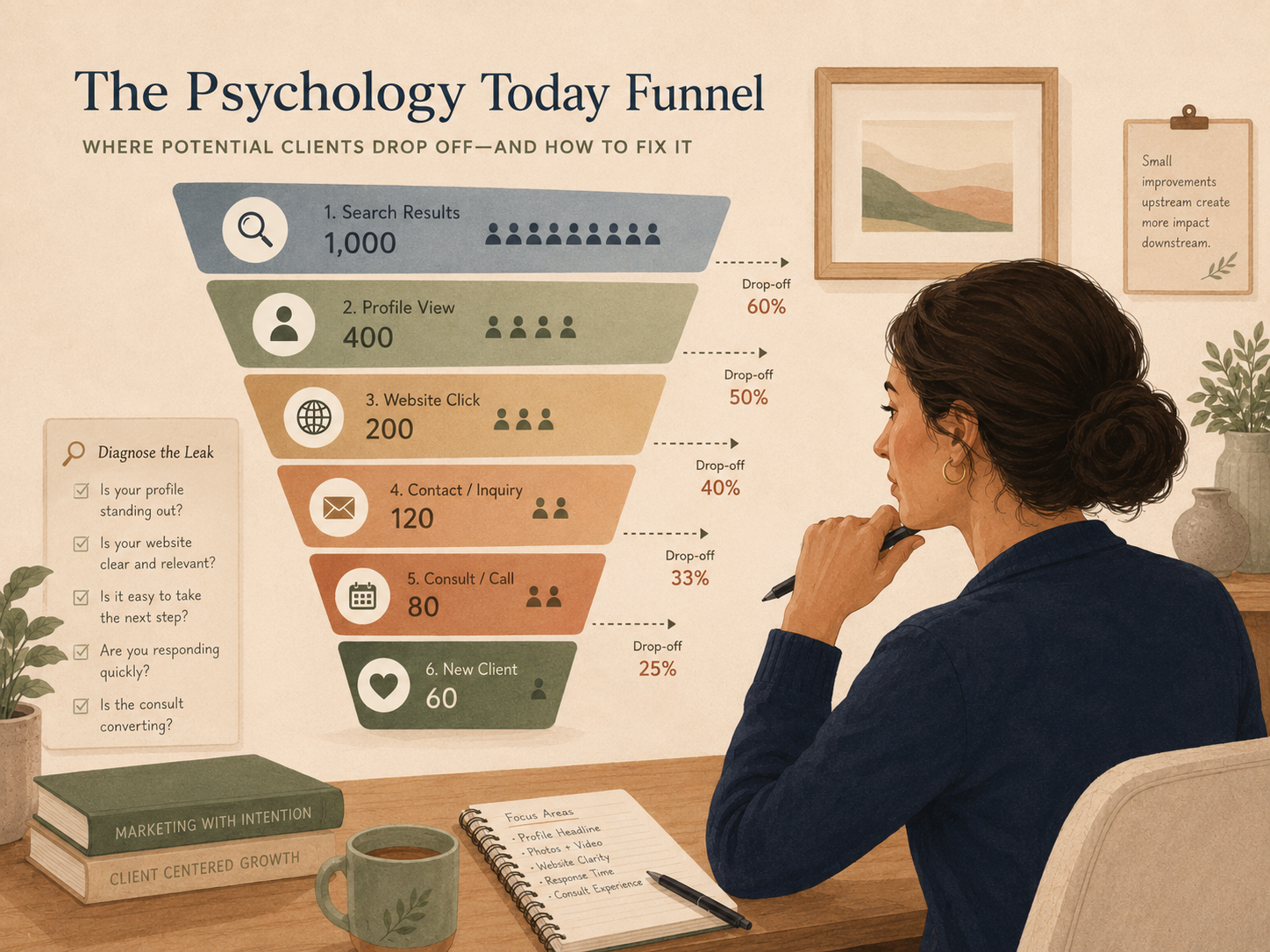
To understand whether Psychology Today is working, separate the path into steps.
Do not only ask whether Psychology Today produced contacts.
Ask where people dropped off.
| Funnel step | What it means | What a problem may signal |
|---|---|---|
| Result views | Your profile appeared in Psychology Today search results. | Visibility, ranking, filters, location, competition. |
| Profile views | Someone clicked from results into your profile. | Click-through, photo, first line, specialty clarity. |
| Website clicks | Someone left PT to learn more on your website. | Interest, comparison behavior, need for more trust. |
| PT contacts | Someone contacted you through PT. | Profile conversion, fit, availability, next-step clarity. |
| Website inquiries from PT | Someone clicked from PT and contacted through your site. | Website conversion and attribution. |
| Consults booked | A contact became a scheduled consult. | Intake speed, fit, response quality, availability. |
| New clients | A consult or inquiry became a client. | Overall channel quality and business impact. |
If result views are low, the problem may be visibility.
If result views are healthy but profile views are low, the problem may be click-through.
If profile views are healthy but contacts are low, the problem may be conversion.
If website clicks are healthy but website inquiries are low, the problem may be the website.
If contacts are happening but consults are not booking, the problem may be intake, fit, speed, fees, or availability.
Practical benchmarks
Use benchmarks as diagnostic ranges, not universal rules.
Psychology Today does not publish official average conversion benchmarks for individual therapist profiles.
So the ranges below should be treated as practical diagnostic ranges, not official platform averages.
They are meant to help a practice owner ask better questions.
For an individual therapist profile
| Metric | Weak | Workable | Strong | Very strong |
|---|---|---|---|---|
| Result views per month | Under 250 | 250–1,000 | 1,000–3,000 | 3,000+ |
| Profile views per month | Under 25 | 25–100 | 100–300 | 300+ |
| Website clicks per month | Under 5 | 5–25 | 25–75 | 75+ |
| PT contacts per month | 0–1 | 1–3 | 3–6 | 6+ |
| New clients per month from PT | 0 | 0.5–1 | 1–2 | 2+ |
For a group practice
For a group practice, the numbers need to be viewed across all relevant profiles and by clinician.
| Group practice metric | Directional monthly range |
|---|---|
| Total PT result views across profiles | 2,000–15,000+ |
| Total PT profile views | 200–1,500+ |
| Total PT contacts | 5–40+ |
| New clients from PT | 2–15+ |
The point is not to chase a universal benchmark.
A solo clinician may only need one good-fit client from Psychology Today each month for the listing to be worthwhile.
A group practice, however, needs to know whether PT is helping fill the whole team or only sending inquiries to the most visible, already-full clinicians.
That is a very different question.
The conversion rates that matter most
Raw numbers are helpful.
Conversion rates are more useful.
| Funnel metric | Formula | Weak | Healthy | Strong |
|---|---|---|---|---|
| Profile view rate | Profile views ÷ result views | Under 2% | 2%–5% | 5%–10%+ |
| Website click rate | Website clicks ÷ profile views | Under 5% | 5%–15% | 15%–30% |
| Contact rate from profile | PT contacts ÷ profile views | Under 1% | 1%–3% | 3%–7%+ |
| Contact rate from results | PT contacts ÷ result views | Under 0.05% | 0.05%–0.20% | 0.20%–0.50%+ |
| Consult booking rate | Consults booked ÷ PT contacts | Under 30% | 30%–50% | 50%–70%+ |
| New client rate | New clients ÷ PT contacts | Under 20% | 20%–40% | 40%–60%+ |
These numbers help separate visibility from conversion.
A profile with low result views needs a different fix than a profile with many views and no contacts.
This is why “optimize your Psychology Today profile” is too vague.
The right action depends on the dropoff.
What the dropoff means
Each Psychology Today problem points to a different fix.
If result views are down
Result views are the top of the Psychology Today funnel.
They tell you how often your profile appeared in search results.
If result views decline by 20% to 30% for several months, it is worth watching closely.
If they drop by 50% or more, treat it as a real channel issue.
Possible causes include more competition in your location, changes in search result distribution, insurance or availability filters, telehealth or in-person search behavior, weaker relevance for specific search categories, more platform-managed profiles, outdated profile content, or a specialty category that has become crowded.
What to review:
- Are your specialties still accurate?
- Are your location and telehealth settings clear?
- Are you competing in a very crowded category?
- Are you listed for the services you most want to attract?
- Are similar profiles appearing above or around you?
- Has your local market become more crowded?
- Are you relying on broad terms like anxiety, trauma, depression, or relationships without naming the specific client situation?
Result-view declines are visibility problems.
Rewriting the whole website may not fix them.
First, understand whether the profile is still appearing often enough to create opportunity.
If profile views are down but result views are stable
This usually means people are seeing the profile but not choosing to click.
That is a click-through problem.
Possible causes include a generic first line, an unclear photo, broad specialties, similar language to nearby therapists, unclear availability, or a listing that does not quickly show who the therapist is best for.
What to fix:
- Rewrite the first two lines around the client’s lived experience.
- Use a more specific opening such as “Clients often come to me when...”
- Clarify the client situations you are best suited for.
- Remove overly broad language that could apply to any therapist.
- Make the profile easier to choose quickly.
A useful test is to place your profile next to ten local competitors and ask:
Would a client know why to click this one?
If the answer is no, the profile may be clinically warm but commercially unclear.
If profile views are steady but contacts are down
This means people are interested enough to read the profile, but not convinced enough to contact you.
That is a conversion problem.
Possible causes include unclear availability, vague fees or insurance expectations, abstract copy, too many listed specialties, unclear therapist style, or no simple explanation of what happens after someone reaches out.
What to fix:
- Make the profile more concrete.
- Explain who is a good fit.
- Clarify the next step.
- Add language that lowers uncertainty.
- Make fees, insurance, location, and availability easier to understand where appropriate.
- Make sure the profile and website tell the same story.
For many therapists, the issue is not that clients do not care.
It is that the client does not feel confident enough to take the next step.
If website clicks are up but contacts are flat
This is one of the most important patterns.
Website clicks are not contacts.
A website click means someone wanted more information.
That can be a good sign.
But it also means the person did not make a decision on the Psychology Today profile alone.
They may be checking fees, availability, location, clinician fit, services, experience, therapy approach, whether the practice feels legitimate, whether the contact process feels easy, whether the clinician profile matches the website, or whether the practice looks current.
If website clicks are high but inquiries are low, the website may be losing people.
Common website problems include:
- The contact button is hard to find.
- The clinician bio is generic.
- The service page does not match the PT profile.
- Fees and insurance are vague.
- The next step is unclear.
- The page creates too many decisions.
- The site looks polished but does not answer client concerns.
- The site talks more about the practice than the client’s situation.
- The therapist’s profile and website feel disconnected.
The fix is not only to improve the PT profile.
It is to improve the path from Psychology Today to the website.
If the client clicks through, the website needs to finish the job.
If contacts are steady but consults are down
This is not a Psychology Today problem anymore.
It is an intake problem.
Possible causes include slow response time, unclear intake process, missed calls, weak follow-up, fee mismatch, scheduling friction, no clear consult offer, poor-fit inquiries, no system for tracking source and outcome, intake replies that are warm but vague, or no second follow-up after the first response.
A practice can generate enough inquiries and still lose growth because the intake system is not strong enough.
This is especially important for group practices.
The owner may assume the marketing source is weak when the real problem is that inquiries are not being matched, followed up with, or converted consistently.
A directory can create the opportunity.
Your intake process decides how much of that opportunity becomes revenue.
If contacts are coming in but they are poor fit
Not all inquiries are equally valuable.
A profile can generate activity and still create the wrong kind of demand.
Poor-fit contacts may include people looking for a service you do not offer, insurance you do not accept, fees you cannot provide, immediate crisis support, a clinician who is full, a specialty outside your focus, a location or schedule you cannot accommodate, or a higher level of care than your practice can safely provide.
If more than half of PT contacts are poor fit, the profile may be too broad.
The fix is not to make the profile colder or less welcoming.
The fix is to make it clearer.
Good marketing does not only attract the right people.
It helps the wrong-fit person self-select out before they spend time contacting the practice.
That saves owner time, admin time, and emotional energy.
For group practices
Psychology Today can hide uneven demand across clinicians.
For group practice owners, Psychology Today can create a misleading picture.
The practice may say:
“We get inquiries from Psychology Today.”
But the better question is:
Who gets them?
Are inquiries going to the owner?
The most experienced clinician?
The lowest-fee clinician?
The clinician who accepts insurance?
The clinician with the clearest niche?
The clinician with the best photo?
The person with the most availability?
The newest hire who needs clients?
In many group practices, demand is uneven.
The owner may be full. One clinician may have a waitlist. Another clinician may be sitting at 8 sessions per week. Another may be getting poor-fit inquiries. Another may have a profile that sounds like everyone else.
If the practice only looks at total PT contacts, it may miss the real issue.
For group practices, track by clinician:
- Result views
- Profile views
- Website clicks
- Contacts
- Consults booked
- New clients
- Poor-fit inquiries
- Days from contact to response
- Days from contact to first appointment
This reveals whether Psychology Today is helping the group practice grow or mostly reinforcing existing visibility around the clinicians who are already easiest to fill.
That distinction matters for hiring.
A group practice should not hire based on total inquiry volume if those inquiries are not reaching the clinicians who need them.
Psychology Today can also build clinician demand, not always practice demand.
This is another detail many group practice owners miss.
Psychology Today is built around individual profiles.
That can be useful.
Clients often want to choose a person, not a brand.
But it also means the platform may build demand around individual clinicians rather than the group practice as a whole.
This can create problems.
A client may remember the therapist, not the practice.
A clinician may leave and take visibility with them.
The owner may pay for multiple profiles without a clear group-level strategy.
The website may not clearly connect the clinician profile to the broader practice.
Intake may struggle to match clients when the person they contacted is full.
This is not a reason to avoid Psychology Today.
It is a reason to connect the directory to a stronger practice system.
For group practices, each clinician profile should still support the larger brand.
That means consistent language about the practice, clear links to the right clinician page, a simple explanation of how intake works, a way to match the client if that clinician is full, service pages that support the profile’s specialty, and tracking by clinician and source.
Otherwise, Psychology Today can become a collection of disconnected profiles rather than a practice growth channel.
The fee question
Is Psychology Today still worth the monthly fee?
For many therapists, yes.
At roughly $30 per month for an individual profile, Psychology Today does not need to produce many clients to be financially worthwhile.
One good-fit client can justify the annual cost many times over.
But cheap does not automatically mean strategic.
A low-cost channel can still create hidden problems if the practice relies on it too heavily, does not track outcomes, or assumes that profile views equal growth.
| Situation | What it means | What to do |
|---|---|---|
| PT produces steady right-fit inquiries | The channel is working | Keep it, improve it, and track it. |
| Views are high but contacts are low | Conversion issue | Rewrite the profile and improve the website path. |
| Result views have dropped sharply | Visibility issue | Review filters, categories, competition, and local search results. |
| Contacts are mostly poor fit | Positioning issue | Tighten specialties, fees, fit, and service clarity. |
| No contacts for 3+ months | Weak current channel | Investigate before assuming it will recover. |
| No views, no contacts for 6+ months | Likely not meaningful right now | Consider whether attention is better used elsewhere. |
| PT sends inquiries only to full clinicians | Matching issue | Improve routing, profile strategy, and clinician-specific pages. |
| PT creates many website clicks but few inquiries | Website issue | Fix the landing path and contact step. |
The goal is not to decide emotionally whether Psychology Today is good or bad.
The goal is to decide what role it should play in your growth system.
The bigger risk
The risk is not paying for Psychology Today. The risk is depending on it.
This is the part practice owners should take seriously.
The risk is not the monthly fee.
The risk is source dependency.
Any single inquiry source can change.
A directory can adjust its algorithm. Google can change search results. A referral partner can retire. A local competitor can become more visible. Insurance panels can shift. A platform can enter the market. Client behavior can change.
If one source creates most of your inquiries, that source is no longer just a marketing channel.
It is a business risk.
| Share of inquiries from one source | Dependency level | Risk |
|---|---|---|
| Under 30% | Healthy | Low |
| 30%–45% | Manageable | Moderate |
| 45%–60% | Risky | High |
| 60%–75% | Fragile | Very high |
| 75%+ | Emergency dependency | Severe |
If Psychology Today accounts for 15% to 25% of your inquiries, a drop matters but may not destabilize the practice.
If Psychology Today accounts for 60% or more, a drop can quickly affect revenue, clinician utilization, owner stress, hiring plans, and cash flow.
That is why diversified inquiry streams matter.
Diversification does not mean every source performs equally.
It means no single source can destabilize the practice by itself.
Why this matters now
Heard’s 2026 Financial State of Private Practice report found that 83% of therapists rely on referrals, 82% use online directories, and the median annual marketing spend is only $500. That means many practices are heavily dependent on a small number of channels.
A simple channel-risk stress test
Imagine a practice receives 40 inquiries per month.
In one scenario, Psychology Today provides 20 of them.
| Source | Current inquiries | If PT drops 50% |
|---|---|---|
| Psychology Today | 20 | 10 |
| Website / SEO | 8 | 8 |
| Referral partners | 7 | 7 |
| Google Business Profile | 5 | 5 |
| Total | 40 | 30 |
A 50% Psychology Today drop creates a 25% total inquiry decline.
That hurts, but the practice still has other sources working.
Now imagine Psychology Today provides 28 of the 40 inquiries.
| Source | Current inquiries | If PT drops 50% |
|---|---|---|
| Psychology Today | 28 | 14 |
| Website / SEO | 5 | 5 |
| Referral partners | 4 | 4 |
| Google Business Profile | 3 | 3 |
| Total | 40 | 26 |
Now the same Psychology Today decline creates a much larger practice-wide problem.
That is the real lesson.
The goal is not to predict exactly what Psychology Today will do next.
The goal is to make sure the practice is not overly exposed to one channel.
A healthier inquiry mix
Psychology Today should be part of the system, not the system.
A therapy practice does not need every marketing channel.
But it should understand where inquiries come from and whether the mix is too dependent on one source.
A healthier inquiry portfolio may include:
| Source | Healthy role |
|---|---|
| Psychology Today | Useful directory visibility, especially for active searchers. |
| Google Business Profile | Local search and map-based intent. |
| Organic website and SEO | More controlled, compounding visibility. |
| Referral partners | Higher-trust inquiries from known sources. |
| Existing and former client referrals | Warm demand, though not fully controllable. |
| Niche service pages | Better-fit traffic for specific concerns. |
| Other directories or platforms | Supplemental visibility. |
| Paid ads | Optional testing or targeted demand capture. |
| Newsletter, social, and community presence | Trust-building and repeated exposure. |
For a stable group practice, a healthier long-term mix might look something like this:
| Source | Healthy share of inquiries |
|---|---|
| Google / organic website | 25%–45% |
| Referral partners | 20%–40% |
| Psychology Today | 10%–30% |
| Google Business Profile | 10%–25% |
| Other directories / platforms | 5%–20% |
| Paid ads | 0%–20% |
| Social / newsletter / community | 0%–15% |
These ranges are not rules.
They are a way to think about risk.
A solo therapist with a full caseload may be comfortable with a simpler mix.
A group practice trying to fill multiple clinicians usually needs more visibility, more tracking, and more source diversity.
The important question is:
If your top inquiry source dropped by 50%, what would happen to the practice?
Monthly review
What practice owners should track every month.
Practice owners do not need a complicated dashboard.
But they do need a few basic numbers.
| Metric | Why it matters |
|---|---|
| PT result views | Shows visibility inside the directory. |
| PT profile views | Shows whether people are clicking your listing. |
| PT website clicks | Shows whether people want to vet you further. |
| PT contacts | Shows direct conversion from the profile. |
| Website inquiries from PT | Shows whether PT is assisting website conversion. |
| Consults booked from PT | Shows intake conversion. |
| New clients from PT | Shows actual business impact. |
| Total inquiries by source | Shows overall growth mix. |
| Percentage of inquiries from top source | Shows dependency risk. |
| Poor-fit inquiry rate | Shows whether visibility is attracting the right people. |
Review trends over three and six months.
One month can be noisy.
A longer trend is more useful.
| Change | How to read it |
|---|---|
| Plus or minus 10% month to month | Normal noise. |
| 15%–25% decline for two months | Watch closely. |
| 30%+ decline for three months | Investigate. |
| 50%+ decline | Treat as a real channel problem. |
This is especially important for group practices.
When clinicians have uneven caseloads, the owner needs to know whether the issue is visibility, matching, intake, profile quality, service demand, or follow-up.
Without tracking, everything feels like a marketing problem.
With tracking, the actual bottleneck becomes easier to see.
What to fix first
The right fix depends on the pattern.
If result views are low, start with visibility.
Review your location, specialties, telehealth settings, insurance filters, and local competition.
Look at the profiles appearing around yours.
Make sure your profile is complete, current, and aligned with the services you actually want to fill.
Also ask whether you are competing in a category that is too broad.
“Anxiety” may be accurate.
But “panic attacks in college students,” “high-functioning anxiety in professionals,” or “social anxiety in teens” may create a clearer fit signal.
Useful tool: Check broader search visibility with the Local SEO Visibility Scanner.
If profile views are low, start with click-through.
Rewrite the opening lines.
Make the profile more specific.
Speak to the client’s situation.
Use language that helps someone quickly understand whether you are a good fit.
Instead of: “I help people with anxiety, depression, trauma, and life transitions.”
Try: “I work with adults who look like they are keeping everything together, but privately feel anxious, irritable, exhausted, and unable to slow down.”
Instead of: “I offer a warm and supportive space for teens.”
Try: “I help teens who shut down, avoid schoolwork, snap at their parents, or say they are fine when everyone around them can tell something has changed.”
Instead of: “I work with couples on communication.”
Try: “I help couples who keep having the same argument, repair for a few days, and then end up right back in the same painful pattern.”
Specificity helps the right person recognize themselves.
Useful tool: Use the Psychology Today Profile Optimizer before doing a full rewrite.
If contacts are low, start with conversion.
Clarify who you help, what the next step is, and what reaching out looks like.
Reduce uncertainty.
Make sure the profile does not stop at warmth and credentials but helps the client make a decision.
Add one clear next-step sentence:
“If this sounds familiar, you can send a message here or visit our website to request a consultation.”
“We currently have daytime openings for telehealth clients in [state].”
“If I am not the best fit, our intake coordinator can help match you with another clinician in the practice.”
A client should not have to guess what happens next.
If website clicks are high but inquiries are low, start with the website.
Look at the page people land on after clicking from Psychology Today.
Does it answer the questions a client is likely asking?
Is the contact path obvious?
Does the clinician bio match the PT profile?
Are fees, availability, services, and next steps clear enough?
Is there a direct link to request a consultation?
Do visitors have to choose from too many options?
Does the page feel current?
A polished website is not enough.
It has to help the person take the next step.
Useful tool: Use the Therapy Practice Website Scanner.
If contacts are good but consults are low, start with intake.
Review response speed, follow-up, scheduling, call scripts, email templates, and source tracking.
Ask:
- How quickly do we reply?
- Do we offer a clear next step?
- Do we answer the practical question the person asked?
- Do we follow up if they do not respond?
- Do we make it easy to book?
- Do we know which inquiries came from PT?
- Do we know which ones became clients?
Many practices lose good inquiries because follow-up depends on memory.
That is not a people problem.
It is a system problem.
If new clients are low despite activity, start with fit.
The issue may not be volume.
It may be the kind of demand the profile is attracting.
Tighten the messaging, service focus, fee clarity, and matching process.
For example, if your private-pay practice gets many inquiries from people looking for insurance, make fee expectations clearer.
If you get crisis-level inquiries your practice cannot serve, clarify level of care.
If your couples therapist keeps getting individual therapy inquiries, rewrite the profile around couples-specific situations.
If a clinician wants teen clients but mostly receives adult inquiries, make the opening lines and specialties more direct.
Better-fit messaging may reduce total inquiries but increase useful inquiries.
That is usually a good trade.
Quarterly audit
The profile audit most practice owners should run.
Once a quarter, review every active Psychology Today profile.
Do not start by asking whether you like the writing.
Ask these questions:
- Who is this profile clearly for?
- What client situation does it name?
- Does the first sentence sound like this clinician or like every therapist?
- Does it match the services we actually want to fill?
- Does it mention availability clearly enough?
- Does it send people to the right page on the website?
- Does it help the right-fit client take the next step?
- Does it help poor-fit clients self-select out?
- Does this clinician need more inquiries, or are they already full?
- Are we paying for a profile that supports the practice’s current goals?
A profile that was useful last year may not match the practice this year.
Clinician availability changes.
Services change.
Insurance changes.
Fees change.
Locations change.
The market changes.
Profiles need to change too.
Fastest starting point
Use the free Psychology Today Profile Optimizer to review one profile first. Start with the clinician who has openings, not the clinician who is already full.
A simple next step
Do not guess whether Psychology Today is working. Diagnose the role it plays.
Pull the last six months of Psychology Today data.
Write down:
- Result views
- Profile views
- Website clicks
- Contacts
- Consults booked
- New clients
- Inquiries from every other source
Then calculate three things:
- Profile view rate: profile views divided by result views.
- Contact rate: contacts divided by profile views.
- Source dependency: percentage of total inquiries coming from Psychology Today.
Those three numbers will tell you more than a vague feeling that PT is “working” or “not working.”
If result views are the problem, work on visibility.
If profile views are the problem, work on click-through.
If contacts are the problem, work on conversion.
If website clicks are the problem, work on the website path.
If source dependency is the problem, build a more diversified inquiry stream.
Psychology Today may still be part of the answer.
But for most growing therapy practices, it should not be the only answer.
If the profile may be the issue
Use the Psychology Today Profile Optimizer to check clarity, fit, specialty language, logistics, trust signals, and next-step strength.
If website clicks are not becoming inquiries
Use the Website Scanner to check whether your practice website makes the next step clear enough for right-fit clients.
If visibility feels weaker overall
Use the Local SEO Visibility Scanner to review local visibility, service page clarity, and basic search presence beyond directories.
If source dependency is the concern
Use the Practice Growth Calculator to see how inquiries, consults, capacity, fees, and conversion affect your growth picture.
Quick self-check
Look at the last 90 days. Which statement feels most true?
- A. We are not showing up enough.
- B. We show up, but people do not click.
- C. People click, but they do not contact us.
- D. People click to the website, then disappear.
- E. People contact us, but consults do not book.
- F. Consults book, but many are poor fit.
- G. Psychology Today still works, but we rely on it too heavily.
Your answer tells you the real work.
Not more panic.
Not random profile edits.
Not canceling out of frustration.
A clearer diagnosis.
That is what makes the channel easier to manage.
