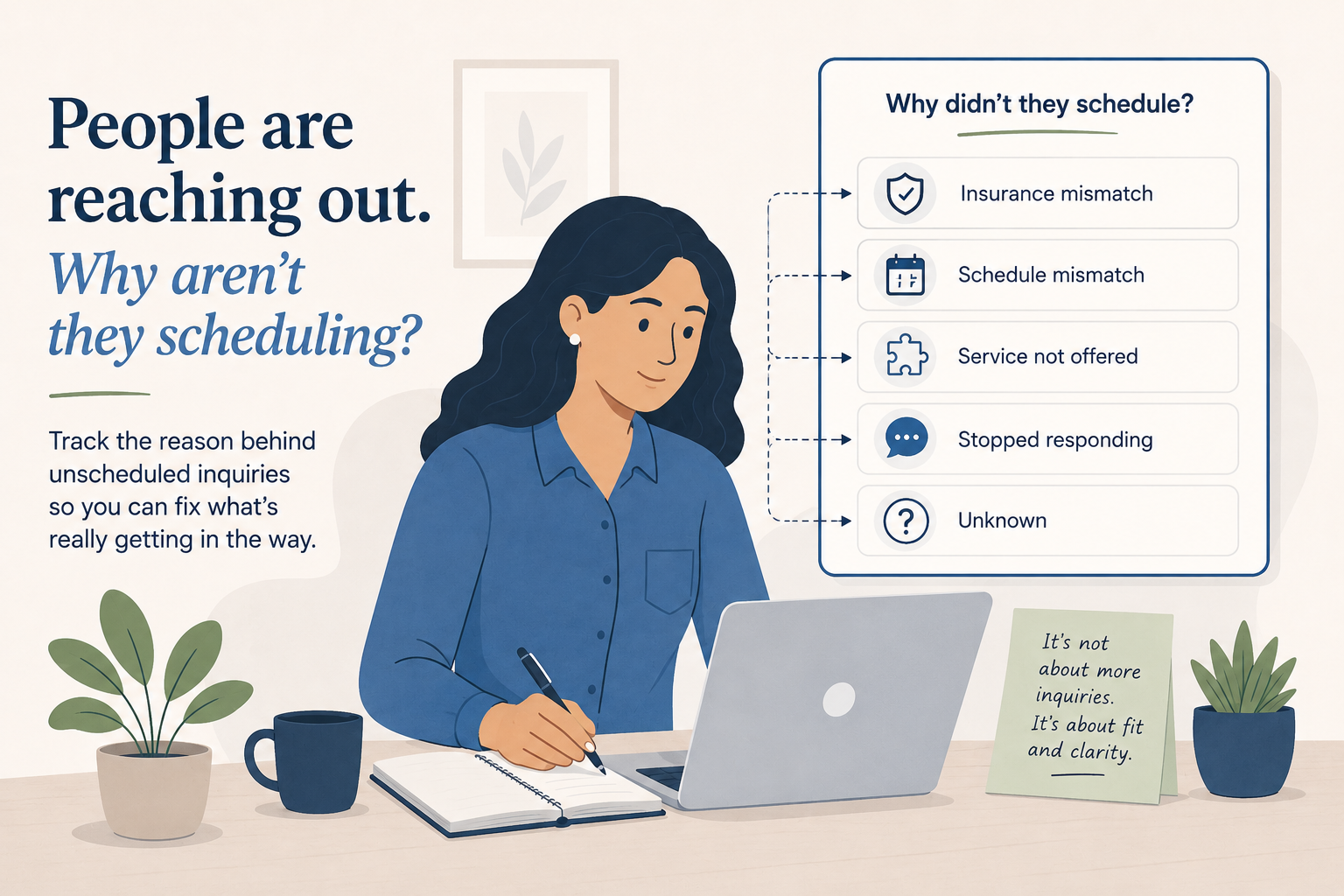
Find the bottleneck. Fix the system. Build steadier growth.
Practice Growth Lab helps therapy practice owners find what is slowing new client growth and build simple systems for steadier inquiries, better visibility, and clearer decisions.
Most therapy practices don’t need more random marketing
They need to know where growth is actually getting stuck.
The issue may be referrals, intake, pricing, website clarity, clinician openings, local visibility, follow-up, or owner time.
The phone used to ring. Now it feels random.
Good months are followed by quiet months, and it is hard to tell what changed.
Directories are doing too much of the work.
Psychology Today, Google, referrals, and word of mouth matter, but relying on one or two sources makes growth feel fragile.
The website looks fine, but people still hesitate.
Visitors may not quickly understand who you help, what happens next, or which clinician is a good fit.
You are screening people you cannot serve.
Too many inquiries are outside your scope, fee fit, insurance fit, location, availability, or service focus.
Some clinicians are full. Others have openings.
The practice looks busy, but capacity is uneven and newer clinicians need more visibility.
The owner is still the growth system.
Referrals, follow-up, website updates, reporting, planning, and decisions still depend too much on you.
Who this is for
For good practices with real demand, strong clinicians, and growth that still feels too inconsistent, unclear, or owner-dependent.
Solo therapists
You want more consistent, right-fit inquiries without relying only on directories, referrals, or hope.
Growing group practices
You need to fill clinician caseloads, improve intake follow-up, and build a more reliable new client growth system.
Established mental health practices
You have momentum, but growth still feels inconsistent, unclear, or too dependent on the owner.
Start with a Practice Growth Audit
For therapy practice owners who want more right-fit inquiries, clearer priorities, and a practical plan before spending more time or money on disconnected tactics.
Find the real bottleneck.
Is growth stuck because of visibility, website clarity, response time, referrals, pricing, capacity, intake, or follow-up?
Know what to fix first.
Turn a long list of possible improvements into a focused 90-day sequence.
Make growth easier to manage.
Build simple systems for intake, local search, referrals, tracking, website updates, and owner-time bottlenecks.
The growth systems that matter most
The work is broader than therapy practice marketing. It connects visibility, referrals, intake, website clarity, pricing, revenue planning, and owner time.
Website and service pages
Improve clarity, positioning, trust signals, local relevance, and the path to inquiry.
Local visibility and search
Strengthen the structure behind service discovery, local search, and high-intent therapy searches.
Referral and partnership workflows
Build practical systems for identifying, contacting, tracking, and following up with partners.
Inquiry and intake follow-up
Reduce missed opportunities with better contact flows, templates, and inquiry tracking.
Pricing and revenue planning
Connect fees, capacity, utilization, service mix, staffing, and revenue goals.
AI-enabled operating workflows
Use AI carefully to reduce admin drag, organize repeatable work, and support better owner decisions.
From scattered marketing activity to a clearer growth system
For a DC-based therapy practice, the work connected service positioning, website structure, local search, intake tracking, staffing, pricing, and faster planning into one system.
7 service pages reached #2–#6 within 72 hours
Seven new DC therapy service pages moved from unranked to positions #2–#6 less than 72 hours after being indexed by Google.
3.5x more inquiries in 2 months
Inquiries increased after improving visibility, website structure, service content, and follow-up systems.
$240K+ estimated revenue opportunity in 3 months
Estimated incremental client lifetime revenue opportunity based on increased inquiry volume and current practice assumptions.
The important part was not just that the pages started ranking quickly. It was that they started ranking for service-specific local searches, where someone is already looking for a particular kind of therapy support in DC.
From unranked to visible
The service pages were not improving from already-established rankings. They moved from unranked to visible shortly after indexing.
Service-specific search intent
The ranking movement happened around specific therapy needs, not broad informational mental health searches.
Stronger local search structure
The new service-page structure helped connect the practice’s services to the local searches people were already making.
Results from one therapy practice engagement. Early rankings can move over time. Revenue impact is estimated based on practice assumptions and is not a guarantee of future results.
Not sure what to fix first?
Start with a Practice Growth Audit. Practice Growth Lab brings 15+ years of growth, pricing, partnerships, operations, analytics, and execution experience to help you find the real bottleneck and turn it into a practical 90-day roadmap.