The Second Reply Matters More Than You Think
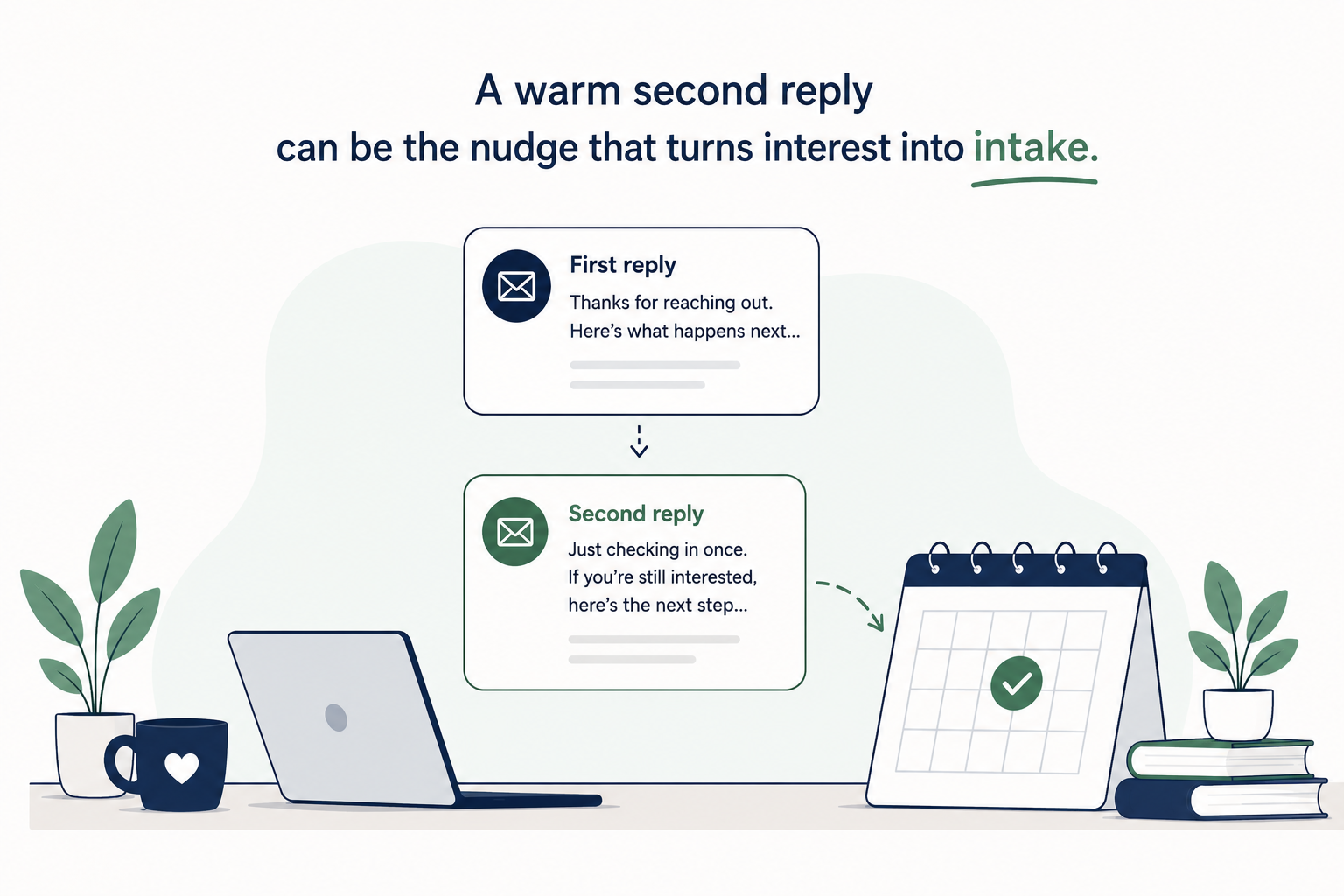
Good-fit people may disappear after the first response. A warm second reply can help them take the next step without feeling pressured.
Have you ever replied to a new client inquiry, felt like the person sounded like a good fit, and then heard nothing back?
No consult booked. No intake form completed. No quick “thanks, I found someone else.” Just silence.
It is easy to assume the person changed their mind.
Sometimes they did. But often, something simpler happened. They got busy. They felt unsure. They were comparing a few practices. They meant to reply later and forgot. Or another practice gave them a clearer next step first.
The second reply is not about chasing people. It is about making sure a good-fit person is not lost because the next step went quiet.
The missed growth leak
Your practice may already have more opportunity than you think
Many practice owners focus on getting more inquiries, but some of the easiest missed opportunities happen after someone has already reached out.
This is especially common in therapy practices because intake happens around real constraints.
The owner may be in sessions. The admin team may need to check availability. Insurance questions may slow the reply down. A potential client may ask about a clinician who is full. Someone may fill out a form at night and receive a response the next day.
None of this means the practice is doing something wrong.
It means intake is a real part of the client experience.
One useful data point
A Harvard Business Review article on online inquiries reported that companies responding within an hour were far more likely to have a meaningful conversation than companies that waited longer. This is not therapy-specific research, but it supports a very human pattern: when someone reaches out, the moment has momentum.
There is also a therapy-specific reason to care about the second reply.
The SimplePractice Annual State of Private Practice Report found that 60.5% of independent clinicians report appointment availability within the next seven days.
That means many practices may have room to help people soon. But availability only helps if the person who reached out can understand the next step and move toward it.
The common assumption
Silence does not always mean the person is not interested
A quiet inquiry is not always a lost inquiry.
Practice owners and intake teams often interpret no response as a clear answer.
“They must not be interested.”
“They probably found someone else.”
“I do not want to bother them.”
Those are understandable thoughts. Therapy is personal. No one wants the intake process to feel pushy, automated, or salesy.
But a respectful second reply is different from pressure.
Pressure sounds like urgency for the practice.
A helpful second reply sounds like clarity for the person.
A good second reply says, “We are still here, here is the next step, and there is no pressure if now is not the right time.”
That small message can reduce uncertainty.
It can also protect your team from relying on memory. Instead of wondering who needs follow-up, the practice has a simple standard: when someone receives a first response but does not reply, they receive one warm second reply.
The practical tip
Write one respectful second reply this week
Do not build a complicated follow-up process first. Start with one message your team can reuse.
The goal is not to follow up forever.
The goal is to make sure the person who already raised their hand gets one more clear, kind chance to move forward.
For most practices, a simple standard is enough:
- Send one second reply after one business day if the person has not responded.
- Keep the message short.
- Restate the next step clearly.
- Mention availability only in general terms.
- Do not include sensitive clinical details.
- Give the person an easy way to opt out by simply not replying.
If the inquiry involved urgent safety concerns, crisis needs, or something outside your usual intake process, follow your practice’s clinical and risk protocols instead of using a general follow-up template.
For ordinary new client inquiries, the second reply can stay simple.
Copy-ready example
A second-reply template you can adapt
Use this as a starting point, then adjust it to match your practice, services, availability, and privacy standards.
Subject: Checking in about your inquiry
Hi [Name],
I wanted to follow up once on your message to [Practice Name].
If you are still interested in taking the next step, you can [schedule a brief consult / complete our inquiry form / reply with a few times that work for you].
We currently have [general availability, such as weekday daytime openings, telehealth openings, or openings with specific clinician types].
If now is not the right time, no need to reply. And if you have already found support elsewhere, I am glad you were able to find care.
Warmly,
[Name]
Notice what this message does not do.
It does not pressure the person to book. It does not over-explain the practice. It does not add a long list of services. It does not include sensitive information about what the person shared.
It simply reopens the door.
Small language change
Try “checking in once” instead of “following up again.” It feels lighter, clearer, and less like the person is being chased.
Example
What this looks like in a practice
Imagine a group therapy practice with three clinicians who have openings.
The practice receives 18 inquiries in a month. The owner feels frustrated because only six people schedule.
At first, the owner thinks the practice needs more marketing.
Then the intake coordinator reviews the open inquiries and notices a pattern.
Here is what they find
- Five people received a first response but never replied.
- Three of those five looked like a possible fit.
- No one followed up because the team did not want to seem pushy.
- The owner assumed silence meant the person was not interested.
The practice does not redesign the whole intake process.
They write one second-reply template.
They save it in the intake team’s shared document.
They decide that every ordinary inquiry gets one second reply after one business day if the person does not respond.
That is the whole change.
It does not create a complicated system. But it does turn follow-up from something that depends on memory into something the team can actually do.
Quick check
How many quiet inquiries get a second reply?
Look at your last 10 new client inquiries that did not schedule. Which answer is closest?
Almost all received one clear second reply.
Some did, but it depends who handled the inquiry.
Most did not receive a follow-up after the first response.
I am not sure. We would need to check email, voicemail, forms, or directory messages.
If your answer is B, C, or D, that does not mean your practice is failing.
It means there may be a simple follow-up gap worth closing.
Try this once this week: choose one place where inquiries arrive, find the people who received a first response but did not reply, and send one respectful second reply where appropriate.
Then notice what happens.
You may find that some people were never a fit. Some had already moved on. But some may simply have needed a clear, kind second step.
