When fast follow-up feels hard to maintain
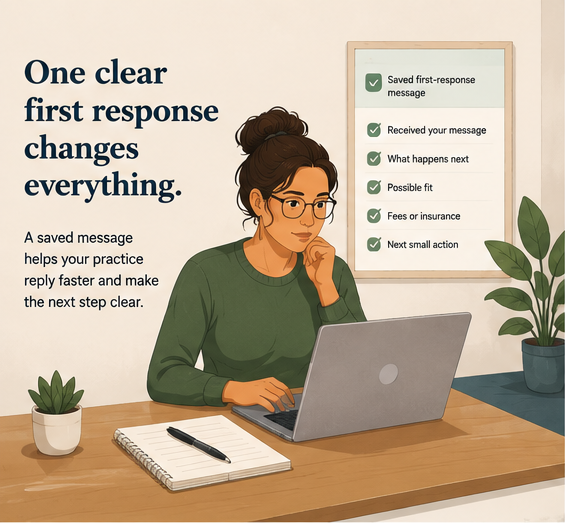
Fast follow-up does not have to depend on memory, adrenaline, or one very responsive owner.
Have you ever wanted your practice to respond quickly to every new inquiry, but the day keeps getting in the way?
A voicemail comes in during sessions. A website form arrives while your admin person is helping someone else. A directory message gets missed until the next morning. A potential client asks about fees, insurance, availability, and fit all at once.
No one is trying to ignore the inquiry.
But the response still takes longer than you wanted.
The hard part is not caring about fast follow-up. The hard part is making the first response easy enough to send consistently.
Why this matters
Availability only helps if people understand the next step.
For many practice owners, slow follow-up feels frustrating because they already know response time matters.
They know someone who reaches out may be nervous, overwhelmed, or comparing a few options. They know a slow or unclear reply can lead to silence.
One therapy practice data point
A SimplePractice 2025 report found that 60.5% of independent clinicians reported appointment availability within the next seven days. That is encouraging. But availability only helps if the person who reaches out can quickly understand what happens next.
One broader response-time data point
A lead response management study found that contacting web-generated inquiries within 5 minutes instead of 30 minutes was associated with much higher odds of making contact.
Therapy is not sales. The tone, ethics, and purpose are different.
But the human behavior still matters.
When someone asks for help, confusion and delay can make the next step feel harder.
The problem
The first response has to do more than people realize.
A good first response is not just “Thanks for reaching out.”
It may need to confirm the inquiry was received, explain the next step, clarify possible fit, share basic fee or insurance information, avoid making clinical promises, include a crisis note when appropriate, and still sound warm.
That is a lot to create from scratch every time.
So the team improvises.
- One person writes a long, thoughtful reply but forgets to include the next step.
- Another person replies quickly but leaves out fees.
- A clinician answers personally because the admin team is unsure what to say.
- The owner gets pulled into every unclear inquiry.
Before long, fast follow-up depends on who saw the message, what kind of question came in, and how busy the practice is that day.
That is not a character flaw. It is a missing system.
The tip
Create one saved first-response message.
Not a cold auto-reply. Not a pushy sales script. Not a complicated intake sequence.
Just one saved message your team can use as the starting point whenever someone reaches out.
The goal is simple: make the first reply easier to send quickly, while still sounding human and clear.
A strong saved first response should answer five basic questions:
- Did you receive my message?
- What happens next?
- Is this practice possibly a fit for me?
- What should I know about fees, insurance, or payment before I go further?
- What is the next small action I should take?
This message is not meant to answer every question.
It is meant to prevent the first response from becoming a bottleneck.
Template
A saved first-response message you can adapt.
Hi [Name],
Thank you for reaching out to [Practice Name]. I’m glad you contacted us.
Based on what you shared, [service/clinician/practice area] may be a possible fit. The next step is [a brief consult call / completing our short inquiry form / scheduling an intake appointment].
We currently have [general availability, such as weekday daytime openings, evening waitlist, telehealth openings, or specific clinician openings].
Before you schedule, here are the basic fee details: [fee per session / insurance accepted / private-pay only / superbill available / we can confirm benefits before your first appointment].
You can take the next step here: [link or instruction].
If you are in immediate danger or this is a mental health emergency, please call 988, call 911, or go to your nearest emergency room. We are not able to provide crisis support through this inbox.
Warmly,
[Name]
A saved first response helps in three practical ways.
First, it lowers the effort required to reply. When your admin team does not have to start from a blank screen, they can respond faster.
Second, it makes the intake experience more consistent. A potential client does not get a completely different first impression depending on who replies that day.
Third, it brings fee and fit clarity earlier in the process.
A saved message does not pressure anyone to schedule. It simply helps the person understand the next step.
Example
What this looks like in a group practice.
Imagine a group therapy practice with five clinicians.
The owner wants inquiries answered quickly, but the practice gets messages from several places: website forms, phone calls, Psychology Today, referral emails, and direct emails.
The admin coordinator is kind and capable, but she often pauses before replying because she needs to check:
- Which clinicians have openings?
- Which insurance plans apply?
- Whether the client sounds like a fit.
- Whether to offer a consult or an intake.
- Whether to mention private-pay fees now or later.
So she waits until she can ask the owner.
The owner is in sessions.
By the time the message goes out, half a day has passed.
The practice creates one saved first-response message with three editable fields:
- Availability.
- Fee or insurance note.
- Next step.
Example reply
“Thanks for reaching out. We currently have daytime telehealth openings with two clinicians. Our self-pay fee is $150 per session, and we are in-network with [plans]. The next step is a brief consult call so we can learn more and help determine fit.”
If the inquiry is clearly outside the practice’s scope, she can use a second version:
If the practice is not a fit
“Thank you for reaching out. Based on what you shared, our practice may not be the best fit for this need. We do not provide [service/higher level of care/crisis support]. A better next step may be [appropriate general referral direction].”
The owner is still available for complex questions.
But the owner is no longer needed for every first reply.
The system does not remove judgment. It removes unnecessary delay.
Quick check
What most often slows down the first response?
Look at your last 10 new inquiries. Which answer is closest?
We needed to check clinician availability.
We were unsure how to explain fees or insurance.
The inquiry came from a channel no one checks consistently.
Admin staff were unsure what to say.
The owner had to approve the response.
We replied quickly, but the next step was unclear.
If you picked B, D, E, or F, a saved first-response message may help this week.
Do not redesign your full intake process yet.
Just write the first reply your practice wishes it could send every time.
Then save it somewhere easy to access: your EHR, your intake tracker, your shared admin document, your secure email templates, or your internal operations guide.
The tool matters less than the habit.
Fast follow-up does not have to depend on memory, adrenaline, or one very responsive owner.
It can start with one saved message.
A clear first response helps the person who reached out feel less lost. It helps your team move faster. It helps fees and fit come up earlier. And it makes your intake process easier to manage without turning it into something cold or complicated.
Try writing one saved first-response message this week.
Your next missed opportunity may not need more marketing.
It may need a clearer first reply.
Want help finding where good-fit inquiries are getting stuck? Start by looking at the first message your practice sends back.
