Why People Do Not Schedule After Reaching Out
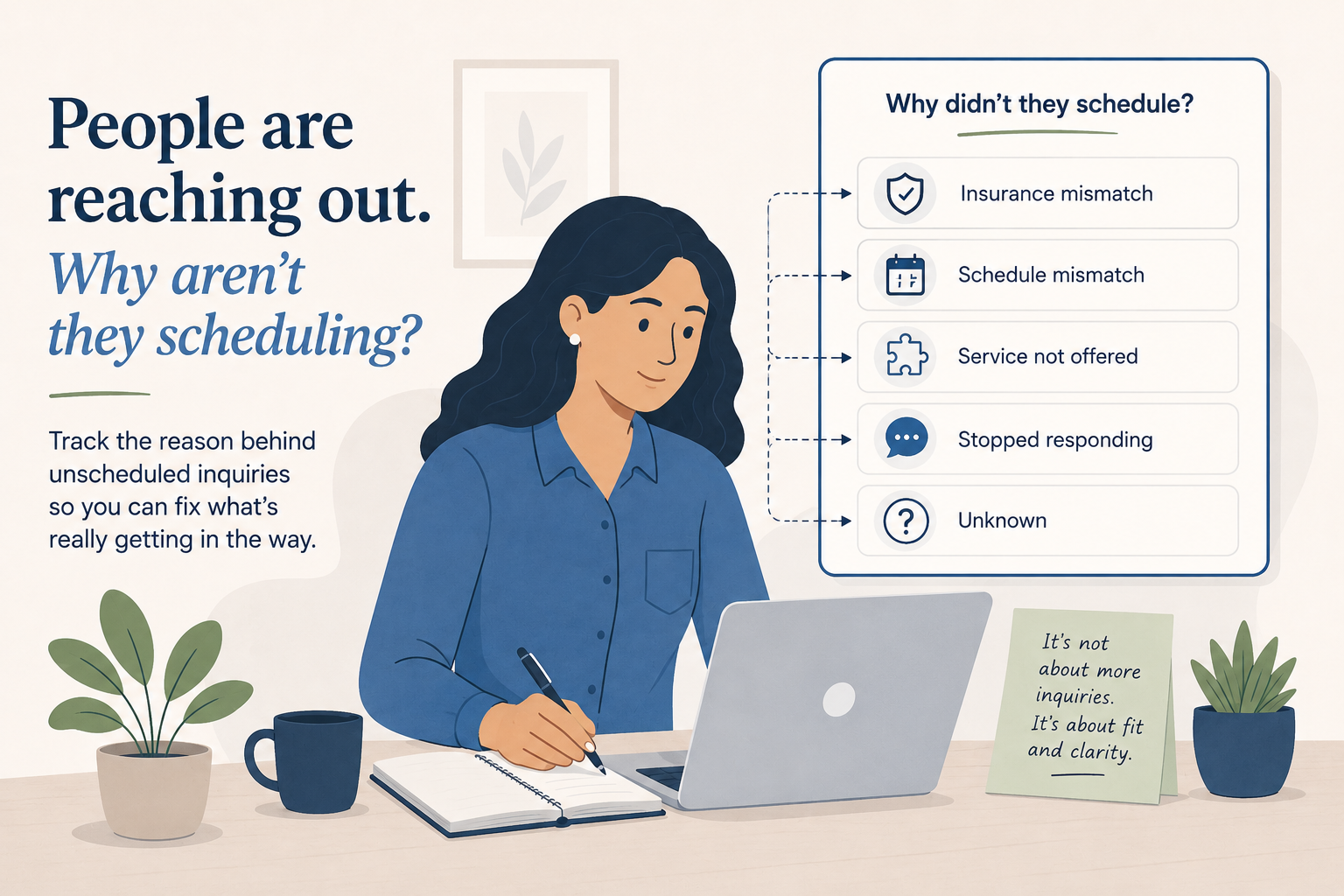
If people reach out but do not schedule, inquiry volume may not be the number you need most.
Have you ever looked at new client inquiries and thought, “People are contacting us, so why are they not booking?”
The contact forms are coming in. The phone is ringing. Maybe your directory profile, referral partners, or Google listing are still bringing people to the practice.
But then some people disappear.
They ask about fees and do not reply. They want an evening appointment you do not have. They need insurance you do not accept. They seem interested on the consult call but never schedule.
SimplePractice’s 2025 private practice report found that 60.5% of clinicians reported appointment availability within the next seven days. The same report noted a real payment gap: the average self-pay rate was $139.75, compared with an average insurance reimbursement rate of $99.75.
So when people reach out but do not schedule, the issue is not always a lack of openings. It may be a mismatch between what the person needs, what the practice offers, and how clearly the next step is explained.
The question is not only, “How many people reached out?” It is, “Why did interested people not schedule?”
The problem
Inquiry volume alone does not explain what is happening.
Many therapy practice owners track whether inquiries are up or down.
That is useful, but it is not enough.
A practice can receive plenty of inquiries and still struggle to fill the right clinician openings. A practice can look busy on the intake side while the schedule still has gaps. A group practice can get attention online but still attract people who are not a fit for the current services, fees, insurance setup, or availability.
This is where owners can accidentally solve the wrong problem.
If 20 people reached out and only 8 scheduled, the first thought may be, “We need better marketing.”
Maybe.
But maybe 5 people wanted an insurance plan you do not accept. Maybe 3 people needed evening appointments and your open clinicians only have daytime availability. Maybe 2 people wanted a service you no longer offer. Maybe several people asked about fees because the website does not explain payment clearly enough.
Those are different problems.
And they need different fixes.
Useful distinction
If people are not finding you, visibility may be the issue. If people are finding you but not scheduling, the issue may be fit, cost, timing, insurance, availability, or unclear next steps.
That is why a simple reason field can be so helpful.
It turns a vague worry into a pattern you can actually use.
The tip
Add one simple reason field to your inquiry tracker.
For the next two weeks, track the main reason each unscheduled inquiry did not book.
Do not build a complicated dashboard. Do not ask your admin team to write long notes. Do not include private clinical details. This is not a clinical record. It is a simple business pattern check.
Add one field to your inquiry tracker:
Reason not scheduled
That is it.
You can add it to a spreadsheet, your internal inquiry log, your EHR workflow if appropriate, or a shared admin document. The tool matters less than the consistency.
The goal is not to perfectly explain every person’s decision. Sometimes you will not know. That is fine. “Unknown” is still useful if it shows up often.
The goal is to stop treating every unscheduled inquiry like a mystery.
What to track
Keep the reason list short enough to use.
If your list has too many categories, your team will stop using it. Start with a few plain-English options.
- Insurance or cost mismatch
- Schedule mismatch
- Service not offered
- Clinician fit not available
- Higher level of care needed
- Location or telehealth mismatch
- No clear next step given
- Person stopped responding
- Unknown
Then add one reflection question when you review the list:
Could this person have known this before reaching out?
That question is where the insight lives.
If people keep asking about insurance you do not accept, the website may need clearer fee and insurance language.
If people keep requesting evening appointments, your availability may need to be clearer before the consult call.
If people keep asking for a service you no longer offer, your service pages, directory profiles, or referral partner language may be outdated.
If good-fit people stop responding after receiving fee information, the fee may not be the only issue. The explanation may be too long, too late, or missing the next step.
This does not mean every person should schedule. Some people should not. A strong inquiry path helps right-fit clients move forward and helps poor-fit clients self-select sooner.
Example
What this looks like in a real practice.
Imagine a group therapy practice receives 24 inquiries over two weeks.
At first, the owner feels encouraged. The website is being found. The contact form is working. People are reaching out.
But only 10 people schedule.
Instead of assuming the practice needs more marketing, the owner reviews the 14 unscheduled inquiries.
| What they find | What it may mean |
|---|---|
| Four people wanted to use an insurance plan the practice does not accept. | Payment information may need to be clearer before people inquire. |
| Three people needed evening appointments, but the only openings were weekday mornings. | Availability may need to be clearer on the website, directory profiles, or first reply. |
| Two people were looking for couples therapy, which the practice no longer offers. | Old service language may still be creating confusion. |
| Two people needed support outside the practice’s scope. | The practice may need clearer fit language and a referral-out path. |
| Two people stopped responding after the first reply. | The first response or follow-up may need to be shorter, clearer, or easier to act on. |
Now the owner has a clearer picture.
This is not simply a “we need more inquiries” problem.
It is a clarity problem.
The next step is much smaller than a full marketing overhaul. The owner updates three things: the fee and insurance section, the current availability note, and the outdated service page language.
Then the team keeps tracking for another two weeks.
What to do next
Use the pattern before changing the whole growth plan.
Once you have two weeks of reasons, do not try to fix everything.
Pick the pattern that appears most often.
If cost or insurance is the pattern, review how your website explains fees, payment options, out-of-network benefits, or insurance limits.
If timing is the pattern, make current availability easier to understand before the consult call.
If poor fit is the pattern, review one service page or one directory profile and make the fit language more specific.
If people stop responding, review your first reply and your follow-up message. Is the next step clear? Is the message easy to read? Does it invite action without pressure?
For a related intake check, read Are you sure you need more marketing?. If you are not sure whether the bigger issue is visibility or follow-up, read Visibility problem or follow-up problem?. If the pattern points back to your website, the therapy website strategy guide can help you think through fit, fees, service pages, and next steps.
You can also use the free Practice Growth Calculator to see whether your growth issue is likely tied to inquiries, consults, intakes, capacity, or revenue goals. If your reason field shows people are confused before they inquire, use the free Therapy Practice Website Scanner to check whether your website makes services, intake, pricing or insurance, and next steps clear enough.
The reason field will not solve the whole practice.
But it will help you make a better next decision.
Quick check
Do you know why people did not schedule?
Look at your last 10 unscheduled inquiries. Which answer is closest?
We know the main reason for almost all of them.
We know some reasons, but not consistently.
We know they did not schedule, but we do not really know why.
We would need to ask the owner, admin team, or intake person from memory.
If your answer is B, C, or D, that does not mean your practice is doing something wrong.
It means there may be a useful pattern hiding in plain sight.
This week, add one field to your inquiry tracker: “Reason not scheduled.”
Use it for two weeks. Keep it simple. Review the pattern before you change your pricing page, your ads, your directory profile, or your whole marketing plan.
The goal is not to make every inquiry become a client.
The goal is to understand what is really happening, so the next fix is easier to choose.
Want help finding where right-fit inquiries are hesitating? Start with the free Practice Growth Calculator, or use a Growth Audit to review the full path from inquiry to scheduled care.
