Therapist Words vs. Client Words: A Better Way to Write Practice Website Copy
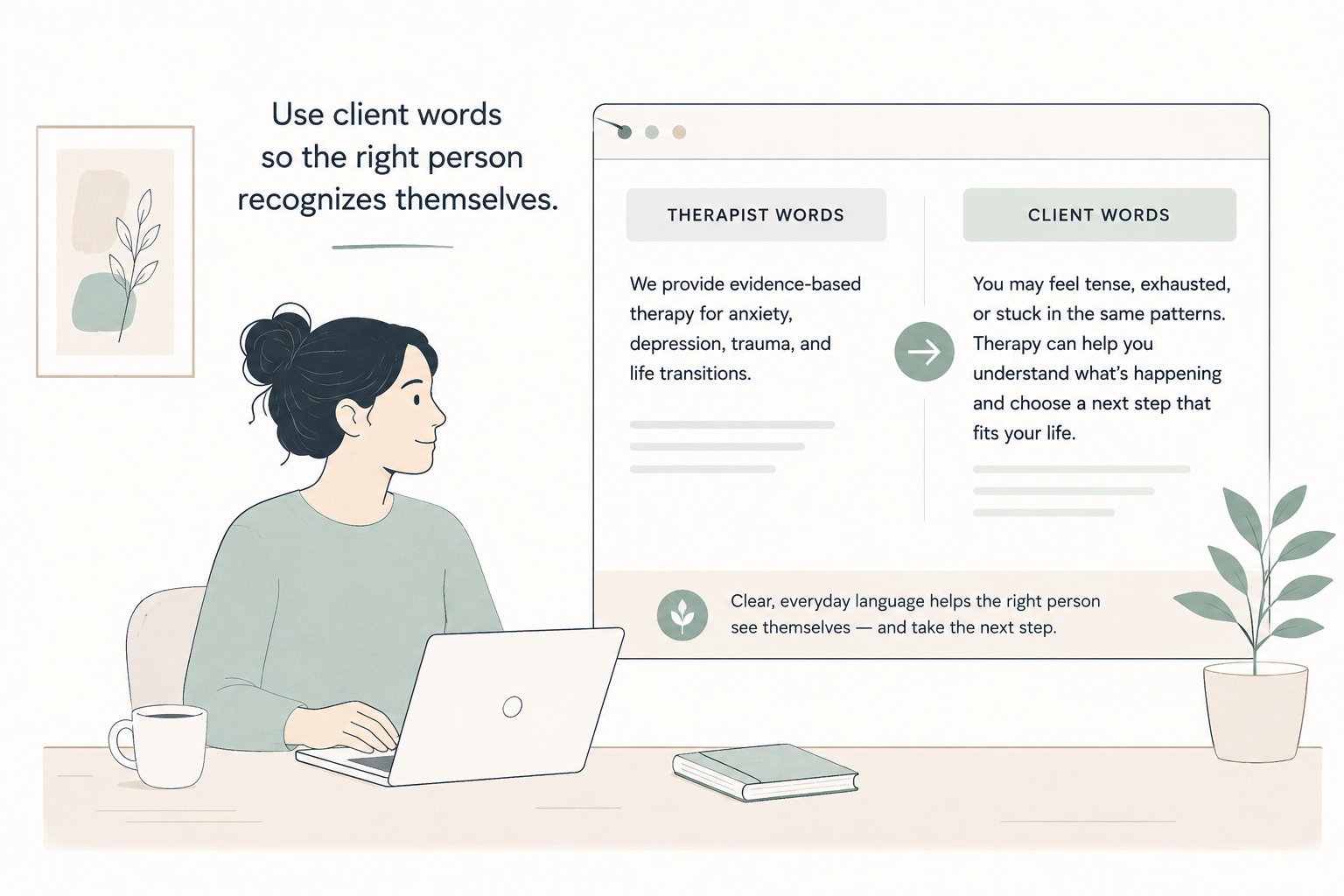
Your website copy can be clinically accurate and still fail to help the right client recognize themselves.
Have you ever read a service page on your therapy practice website and thought, “This is true, but it feels like every other therapist could say it too”?
That is a common problem.
The page may be warm. It may be ethical. It may describe the therapy accurately. But if it is written mostly in therapist words, the client may not see their real-life problem clearly enough to take the next step.
SimplePractice’s 2025 private practice report found that 62.7% of clinicians used online appointment requests. That is a useful reminder for therapy practice websites: the contact option may already be there, but the words before the button still have to help a right-fit visitor feel clear enough to use it.
This week, rewrite one visible block of copy so it sounds less like a clinical description and more like the client’s lived experience.
The common copy problem
Why accurate copy can still feel vague
Therapist words often describe the service. Client words describe the moment that made someone start looking for help.
A service page might say:
“We provide evidence-based therapy for anxiety, depression, trauma, and life transitions.”
There is nothing wrong with that sentence.
It is accurate. It is professional. It may even include important search terms.
But it does not help a visitor quickly answer, “Is this about me?”
Someone looking for therapy may not be thinking in neat clinical categories. They may be thinking, “I cannot turn my brain off.” “I am snapping at people I love.” “I keep functioning, but I feel like I am barely holding it together.” “I know something needs to change, but I do not know where to start.”
That does not mean your website should become dramatic, fear-based, or overly emotional. It means the first few lines should help the right person recognize the situation that brought them there.
This is especially important on service pages, homepage sections, clinician bios, directory profiles, and any page where visitors are deciding whether to reach out.
The practical tip
Rewrite one block using the client recognition test
Pick one paragraph on one important page and ask: “Would a right-fit client say this to a friend?”
Do not rewrite your whole website this week.
Choose one visible block of copy. A homepage opening. A service page introduction. A clinician bio opening. A directory profile paragraph.
Then look for the words that are more common in clinical conversations than client conversations.
- Evidence-based treatment
- Life transitions
- Relational challenges
- Emotional regulation
- Processing trauma
- Executive functioning support
These phrases can still belong on the page. They may be useful later, especially when you explain your approach, credentials, modalities, and scope.
But they should not always carry the first job.
The first job is recognition.
Try writing one sentence that sounds more like the client’s real-life problem. Then add one sentence that explains the kind of support you offer. Then give one clear next step.
Before and after
A more specific version of client-facing copy
The stronger version is not louder. It is clearer.
| Before: therapist words | After: client words |
|---|---|
| We offer evidence-based therapy for anxiety, depression, trauma, and life transitions. | You may look like you are managing from the outside, but inside you feel tense, exhausted, or stuck in the same patterns. Therapy can help you slow down, understand what is happening, and choose a next step that fits your life. |
| Our clinicians use a compassionate and collaborative approach. | You do not have to arrive with the perfect explanation. We will help you sort through what has been feeling hard and decide whether this kind of support is the right fit. |
| Contact us to schedule an appointment. | Start by sending a short inquiry. We will reply with the next step, current availability, and whether one of our clinicians may be a good fit. |
Important note
Use examples like these as a starting point, not a script. Adapt your copy to your niche, licensure, ethics, services, availability, and actual client experience.
What changed
The rewrite makes four things easier
The stronger version does not promise an outcome. It does not pressure the visitor. It does not overstate what therapy can do.
It simply gives the reader more to recognize.
1. Clearer audience. The rewrite speaks to someone who is functioning but struggling internally. That is more specific than “anxiety, depression, trauma, and life transitions.”
2. Stronger client recognition. Words like tense, exhausted, stuck, and same patterns are closer to how many people describe their experience before they know what kind of therapy they need.
3. Lower friction. “You do not have to arrive with the perfect explanation” reduces pressure for the person who is unsure how to describe what is happening.
4. A more obvious next step. “Send a short inquiry” is easier to act on than a vague invitation to contact the practice.
This is the same reason website clarity matters more than many owners realize. A therapy website can look polished and still leave people unsure whether the practice helps with their situation. For a broader website check, read why therapy website visitors do not become inquiries.
For a bigger growth-system view, you can also read what to fix before spending more on marketing. Sometimes the issue is not visibility. Sometimes people are finding the practice but not recognizing fit quickly enough.
Quick check
Would a client say this?
Look at one page on your website and choose the answer that feels closest.
A right-fit client would likely say, “That sounds like me.”
The page is warm and accurate, but it could describe many practices.
The page mostly lists services, specialties, credentials, or modalities.
I am not sure what a client would recognize first.
If your answer is B, C, or D, that does not mean the page is bad.
It means there may be one useful paragraph to rewrite.
Start with the first paragraph on one service page. Add one sentence that names the client’s real-life situation. Add one sentence that explains how the practice helps. Add one sentence that gives the next step.
That small rewrite can make the page easier to understand without turning your website into something salesy.
Helpful next reads and tools
Use client language before adding more content
If your website has traffic but not enough right-fit inquiries, start with clarity before adding more pages. Read why your therapy practice homepage may be saying too much.
For a broader growth planning view, read therapy practice business plan and growth plan.
Free resource: use the Therapy Practice Website Scanner to check whether your website makes services, intake, pricing or insurance, referral fit, and the next step easier for right-fit clients to understand.
Free resource: use the Practice Growth Calculator if you want to compare website clarity, inquiries, consults, capacity, pricing, and follow-up in one place.
One clearer paragraph can help the right person feel less lost. Try rewriting one service-page opening this week before changing your whole website.
