The poor-fit inquiry rate most therapy practices never count
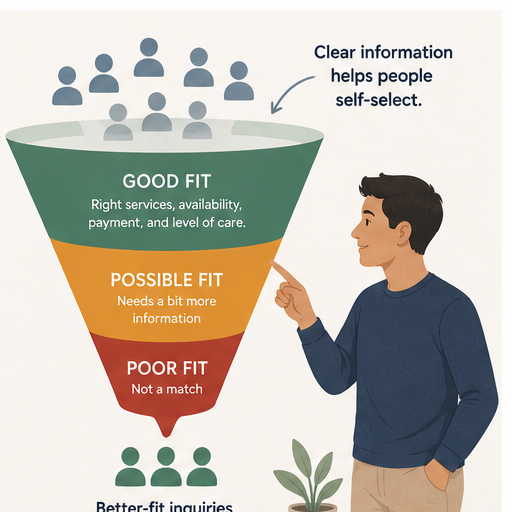
Before you try to get more inquiries, check how many of your current inquiries were never a realistic fit.
Are you getting inquiries that take time, attention, and follow-up… but were never likely to become right-fit clients?
This happens more often than many practice owners realize.
The phone rings. Website forms come in. Psychology Today messages arrive. Referral partners send people your way. On the surface, it can look like demand is healthy.
But when your intake team looks closer, many of those inquiries may not match what your practice can actually offer.
They need a service you no longer provide. They want insurance you do not accept. They need evening appointments when your evening slots are full. They are looking for a clinician type you do not currently have. They need a higher level of care. They live outside your licensed service area.
None of this means your marketing is failing.
It may mean your practice is attracting attention without giving people enough information to self-select before they reach out.
SimplePractice’s 2025 private practice report found that 43% of providers reported zero hours of formal business training, despite being responsible for practice finances and operations. In the same report, administrative burden is named as one of the major pressures on independent clinicians.
Poor-fit inquiries are not just a marketing issue. They create owner time, admin time, intake confusion, and repeated “we are not the right fit” conversations.
The problem
Total inquiry volume can hide the real issue.
Most practices count inquiries as one big number.
“We had 42 inquiries this month.”
That number can be useful, but it is incomplete.
Because 42 inquiries can mean very different things depending on fit.
One practice may have 42 inquiries and 34 are realistic matches for services, fees, availability, and level of care.
Another practice may have 42 inquiries and only 14 are realistic matches.
Those two practices do not have the same growth problem.
The first practice may need better follow-up or scheduling support.
The second practice may need clearer positioning, service pages, referral language, or directory profiles.
But if both owners only look at total inquiry volume, they may both come to the same conclusion: “We need more marketing.”
That may not be true.
More inquiries can create more work if the same percentage of people are the wrong fit.
Before you try to increase inquiry volume, check inquiry quality.
The tip
Track your poor-fit inquiry rate for the last 30 days.
You do not need a complicated dashboard. You do not need to rebuild your intake system. You do not need to judge every inquiry perfectly.
Start with one simple labeling exercise.
Look at every new inquiry from the last 30 days and label it as one of three categories.
| Inquiry label | What it means |
|---|---|
| Good fit | The person appears to match your services, availability, payment options, location or licensure rules, and level of care. |
| Possible fit | The person might be a fit, but one or two details need clarification. |
| Poor fit | The person clearly does not match what your practice can provide right now. |
Then add one short reason for each poor-fit inquiry.
Keep the reason broad and practical. Do not store unnecessary clinical details.
Use simple categories: wrong service, wrong insurance or payment fit, wrong schedule, wrong location or licensure fit, wrong age group or population, higher level of care needed, no clinician match, service no longer available, referral partner mismatch, or other.
Then calculate:
Poor-fit inquiry rate = poor-fit inquiries ÷ total inquiries x 100
That is it.
The goal is not to make your practice sound exclusive.
The goal is to see whether your current visibility is bringing the right people to the right next step.
Example
What this might reveal in a group practice.
Imagine a group therapy practice reviews 45 inquiries from the last 30 days.
| Inquiry quality | Number of inquiries |
|---|---|
| Good fit | 19 |
| Possible fit | 9 |
| Poor fit | 17 |
At first, the owner thought the practice needed more inquiries.
But the poor-fit inquiry rate is 38%.
That means more than one-third of the people reaching out are creating intake work without having a clear path to care at the practice.
Then the team reviews the top mismatch reasons.
| Poor-fit reason | Count |
|---|---|
| Insurance not accepted | 6 |
| Evening availability needed | 4 |
| Service no longer offered | 3 |
| Higher level of care needed | 2 |
| Out of state | 2 |
Now the next step is much clearer.
This practice does not need to rewrite the entire website.
It needs to make three things easier to understand: which insurance plans are accepted, which clinicians currently have evening availability, and which services are currently available.
That may mean updating the fees or insurance page, adding a short availability note, removing an outdated service, and giving referral partners a clearer “best fit” description.
It may also mean checking whether directory profiles are attracting the wrong people. If Psychology Today is sending many poor-fit inquiries, the first step is not always canceling the listing. It may be improving the profile so potential clients understand fit, logistics, and next steps before they message you. The free Psychology Today Profile Optimizer can help check that.
If the mismatch is happening on the website, use the free Therapy Practice Website Scanner to review whether your website clearly explains who you help, how intake works, and what someone should do next.
And if the issue is broader visibility, especially local search, read Local SEO for therapists: how to show up for right-fit local searches. More visibility helps most when it points the right people toward the right services.
Why this works
One-off mismatches become useful when you count the pattern.
Poor-fit inquiries are easy to dismiss one by one.
A single insurance mismatch feels normal. A single schedule mismatch feels normal. A single referral for a service you do not offer feels normal.
But when you count the pattern, you may see something important.
Your website might be too broad. Your referral partners might not know who to send. Your directory profiles might list too many specialties without explaining fit. Your service pages might be accurate but not practical enough. Your intake form might not collect the details that matter early.
That is useful information.
Because the fix for poor-fit inquiries is usually not “try harder.”
It is clearer language.
Instead of: “We work with adults, teens, couples, and families.”
Try: “We currently have openings for adults seeking support with anxiety, burnout, and relationship stress. We do not currently offer couples therapy or child therapy.”
Instead of: “Contact us to learn more about insurance.”
Try: “We are in network with Aetna and Optum. We are not currently in network with Medicaid or Medicare. If you are using out-of-network benefits, we can provide a superbill.”
Instead of: “We offer trauma-informed care.”
Try: “This service may be a fit for adults who want weekly outpatient therapy for trauma-related stress. We are not a crisis service and do not provide intensive outpatient or emergency care.”
Clearer language is not cold.
It is kind.
It helps right-fit clients move forward with less confusion. It helps poor-fit clients avoid waiting for an answer that will disappoint them. And it helps your team spend more time on inquiries your practice can actually serve.
Quick check
Look at your last 10 inquiries.
Which answer is closest?
Most were a strong fit.
Some were a fit, but several needed clarification.
Many were clearly not a fit.
I do not know because we do not track fit reasons.
If your answer is C or D, do not change your whole marketing plan yet.
Start smaller.
Label the last 30 days of inquiries. Count good fit, possible fit, and poor fit. Then write down the top three mismatch reasons.
That one small review can show whether you have a visibility problem, a positioning problem, a referral clarity problem, a website clarity problem, or an intake matching problem.
More inquiries are not always better.
Better-fit inquiries are easier to manage, easier to respond to, and more likely to become right-fit clients.
Try counting this once before adding more marketing.
Want help finding why your practice is getting poor-fit inquiries? Start with the free Therapy Practice Website Scanner or review your directory language with the Psychology Today Profile Optimizer.
