Does Your Therapy Website Explain What Therapy Feels Like?
Your website may explain what therapy is. But does it explain what therapy with your practice may actually feel like?
Have you ever looked at your therapy website and thought, “This is accurate, but I’m not sure it helps someone feel ready to reach out”?
The page may list your services. It may mention anxiety, trauma, relationships, parenting, burnout, or life transitions. It may include credentials, fees, insurance details, and a contact button.
All of that matters.
But a potential client may still be wondering something quieter:
“What will it actually be like to sit with you?”
Clients often want to understand the experience, not just the clinical service.
The hidden hesitation
Why this matters
A nervous website visitor is not only comparing credentials. They are trying to imagine the next few weeks of care.
Therapy is a personal decision. It is also a practical decision.
A client may be thinking about cost, schedule, emotional readiness, privacy, childcare, insurance, past therapy experiences, or whether they will feel judged.
That is a lot to hold before filling out a contact form.
One useful data point
SimplePractice data found that average therapy fees varied from $122 to $227 per session across states and regions in 2023–2024. When someone is considering that kind of investment, vague website language can make the decision feel harder than it needs to be.
There is also the access side of the picture. A 2025 HRSA workforce brief reported that 48% of U.S. adults with a mental illness did not receive treatment in 2024. The report also names high out-of-pocket costs, coverage gaps, provider shortages, and other barriers as reasons care can be hard to access.
Your website cannot solve all of those barriers.
But it can reduce one avoidable barrier: uncertainty.
When a page only says, “We provide evidence-based therapy for anxiety, depression, and relationship issues,” it may be clinically accurate. But it does not help the reader imagine the first session. It does not tell them how the conversation starts. It does not explain whether they will be pushed, guided, listened to, assessed, given homework, or expected to know exactly what to say.
For some right-fit clients, that missing clarity is enough to pause.
The common gap
The sentence many websites are missing
Many therapy websites explain what the practice treats, but not what the client can expect.
This gap is easy to miss because practice owners know the experience already.
You know how you welcome someone. You know how you pace the first session. You know how you ask questions. You know whether you tend to be structured, collaborative, gentle, direct, skills-based, exploratory, or practical.
But the client does not know that yet.
They may only see a list of conditions, modalities, and credentials.
That can make your practice sound similar to many others, even when the actual experience is very different.
The goal is not to promise an outcome. The goal is to make the first step feel easier to understand.
This is especially important for private-pay practices, group practices, and practices with several clinicians.
If someone is paying out of pocket, they often need more clarity before they call. If someone is choosing from several clinicians, they need help understanding fit. If someone has had an uncomfortable therapy experience before, they may be quietly scanning for emotional safety.
A single sentence can help.
The practical tip
Add one plain-language sentence about the first few sessions
Do not rewrite your whole website. Start with one sentence.
Choose one service page, one clinician bio, or one fees page. Add a sentence that helps a potential client understand what the beginning of therapy may feel like.
Use this simple structure:
Copy prompt
“In the first few sessions, we usually __________ so you can __________ without feeling like you have to __________.”
Here are a few examples you could adapt:
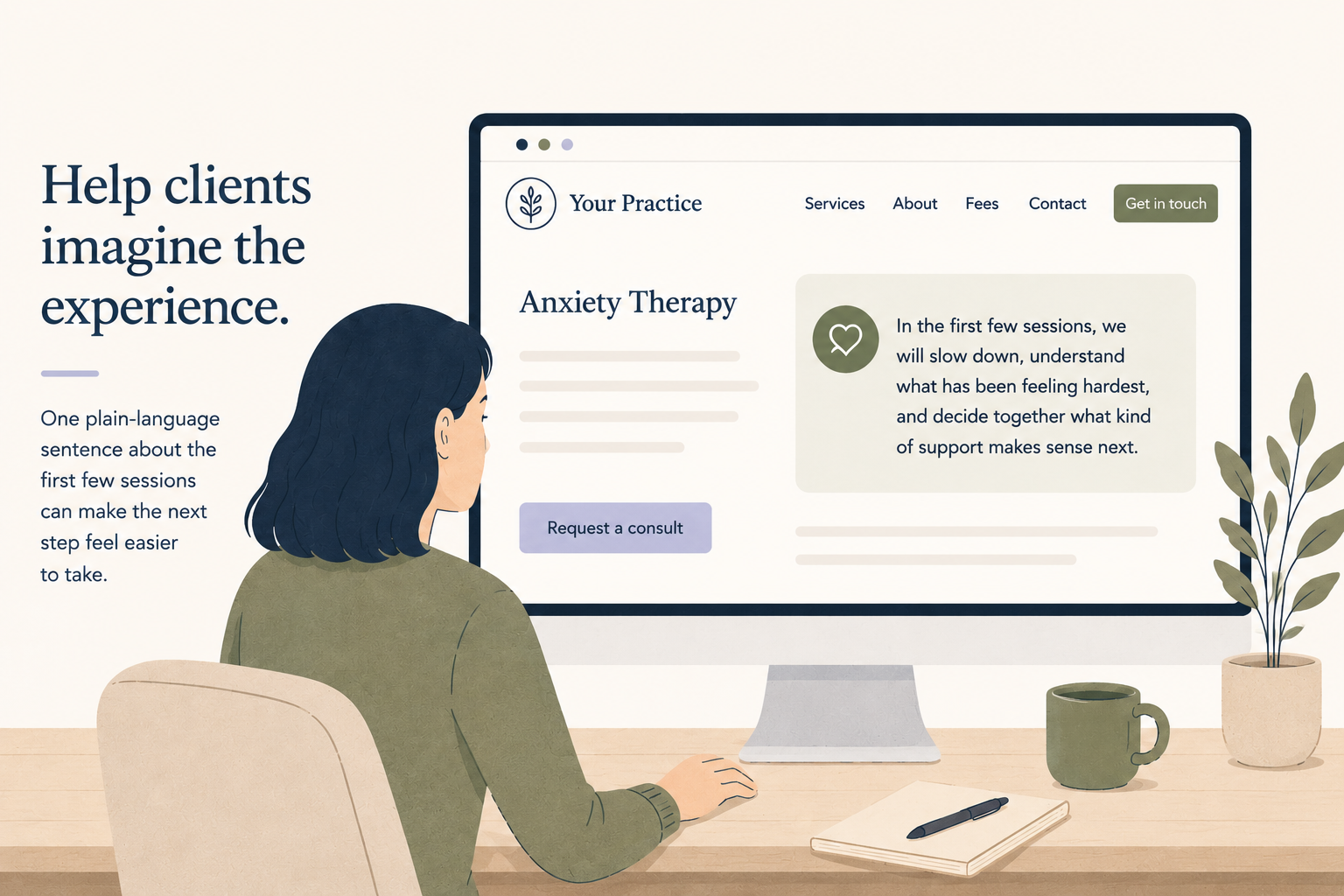
- “In the first few sessions, we will slow down, understand what has been feeling hardest, and decide together what kind of support makes sense next.”
- “You do not need to arrive with everything figured out. Early sessions are usually about getting oriented, naming what you want help with, and making a plan that feels manageable.”
- “For anxiety therapy, we usually start by understanding how anxiety shows up in daily life, what you have already tried, and what kind of support would feel most useful right now.”
- “For couples therapy, the first few sessions focus on understanding each person’s perspective, clarifying the patterns that keep repeating, and deciding whether ongoing work with us feels like a good fit.”
- “For parents reaching out for a teen, we start by learning what has changed, what support your teen may be open to, and what next step feels appropriate.”
Notice what these sentences do.
They do not guarantee results. They do not over-explain the clinical model. They do not pressure the person to schedule. They simply make the next step easier to picture.
That kind of clarity can support trust before intake.
Where it belongs
Put the sentence where hesitation already happens
The best place for this sentence is the page someone reads right before deciding whether to reach out.
For many practices, that may be a service page.
For example, someone reading your anxiety therapy page may already know they have anxiety. What they may not know is whether your approach will feel practical, warm, structured, exploratory, or overwhelming.
For a private-pay practice, this sentence may also belong near the fee information. Not because the sentence “justifies” the fee, but because cost and emotional clarity often sit together in the client’s mind.
The visitor may be thinking:
- “What am I paying for?”
- “Will this feel too intense?”
- “Will I know what to say?”
- “Will the therapist understand my situation?”
- “What happens if I am not sure this is the right fit?”
You do not need to answer all of these at once.
Just choose one moment of uncertainty and add one sentence that makes the experience easier to imagine.
Keep it simple
If the sentence sounds like something you would actually say on a consult call, it is probably closer to the right language.
Example
What this looks like in a practice
A small wording change can make a polished page feel more human.
Imagine a group therapy practice with a strong anxiety therapy page.
The page lists anxiety, panic, perfectionism, overthinking, work stress, and social anxiety. It mentions CBT, mindfulness, and values-based work. It includes a contact button and notes that several clinicians have openings.
The page is accurate.
But it still feels a little distant.
So the practice adds this sentence near the top:
“In the first few sessions, we will look at how anxiety is showing up in your daily life, what has helped or not helped so far, and what kind of support would feel realistic for you right now.”
That sentence does not promise a cure. It does not make therapy sound easy. It does not pressure anyone.
It simply helps a nervous reader understand the beginning.
This can also help the intake team.
When clients arrive with a clearer sense of what to expect, they may ask more useful questions. The admin team may spend less time explaining the basics. Clinicians may receive inquiries from people who already have a better sense of fit.
Not every visitor will schedule. Not every inquiry will be right-fit.
But the page will do a better job of answering the question many clients are silently asking.
Quick check
Does your website explain the experience?
Open one service page and ask yourself which answer is closest.
Yes. A client can understand what the first few sessions may feel like.
Somewhat. The page explains the service, but not the beginning of therapy.
Not really. The page mostly lists concerns, modalities, or credentials.
I am not sure. I know what we mean, but I do not know how a new visitor would read it.
If your answer is B, C, or D, this is a useful place to start.
Do not rewrite the whole page today.
Add one plain-language sentence about what clients can expect from the first few sessions. Then read it out loud. If it sounds calm, honest, and true to your actual work, keep it.
For a broader website review, read the therapy website strategy guide. If visitors are comparing options but not choosing, this article on whether your therapy website is helping clients choose may also help.
You can also try the free Therapy Practice Website Scanner to check whether your website makes services, intake, pricing, and next steps easier to understand.
Your website does not need to explain everything. It needs to make the next step feel clear enough for the right person to take it.
