Google Business Profile for Therapists: What to Fix First
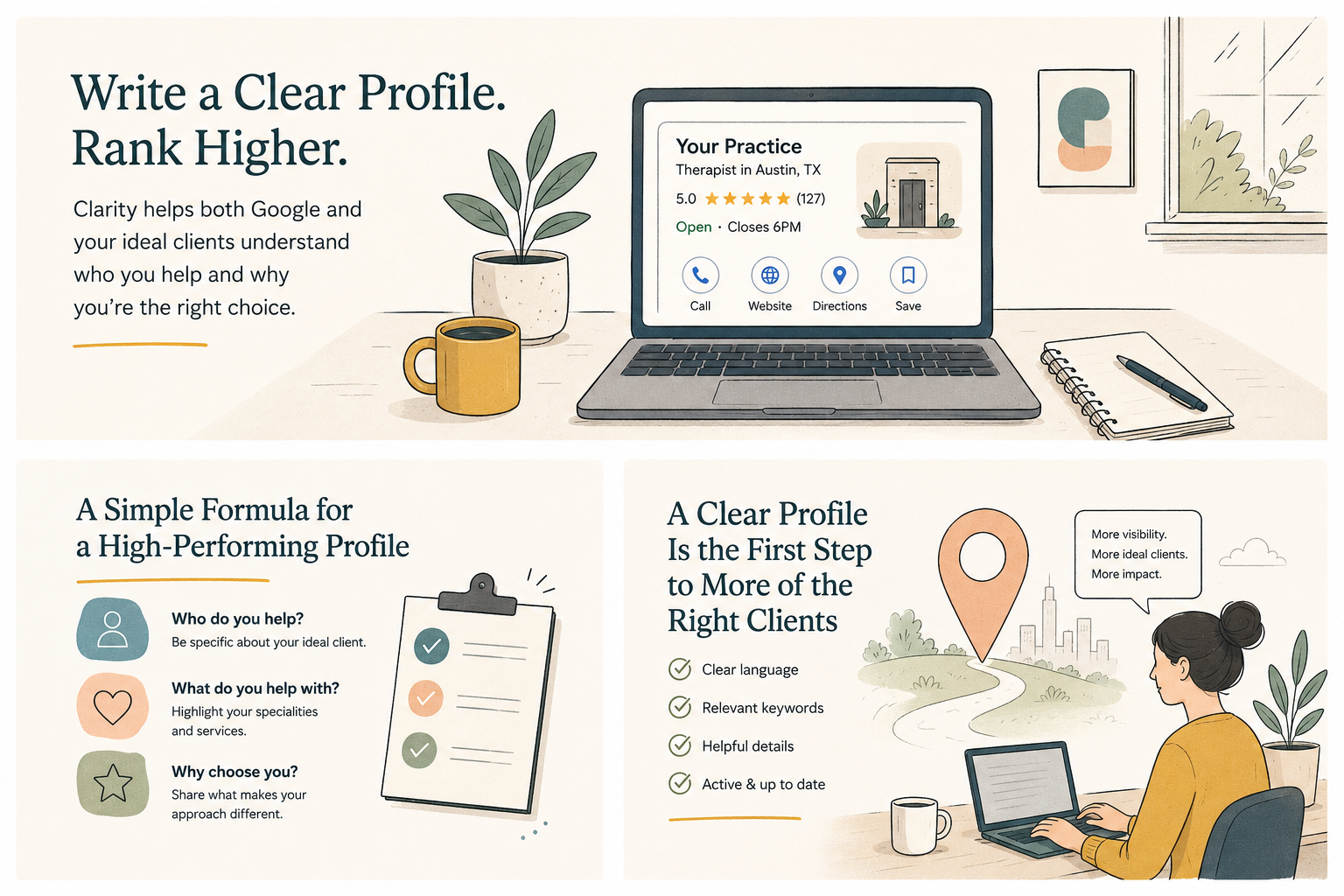
Before you worry about ranking higher on Google, check whether your Google Business Profile clearly helps the right local searcher take the next step.
Have you ever searched for your therapy practice on Google and thought, “We have a profile, but I am not sure it is actually helping”?
The listing exists. The address is there. The phone number works. Maybe there are a few photos, a few services, and a link to the website.
But when you look at it from the point of view of a potential client, it may still feel thin.
They may not know who you help, whether your practice is a fit, what services are available, or what they should do next.
A Google Business Profile can be visible and still be unclear. The first fix is not always more reviews, more posts, or more keywords. It is clearer fit and a clearer next step.
The local visibility problem
Local searchers are not studying your practice. They are trying to decide quickly.
Someone who finds your practice on Google is often asking, “Is this close enough, relevant enough, and easy enough to contact?”
That person may be looking between meetings. They may be searching from their phone. They may be comparing three practices. They may be helping a partner, teen, parent, or friend. They may not have the energy to decode vague therapy language.
This is why your Google Business Profile matters.
It may be one of the first places a local searcher sees your practice. It may also be one of the last places they check before deciding whether to call, click, request an appointment, or keep looking.
One useful data point
Heard’s 2026 Financial State of Private Practice report found that therapists reported referrals or word of mouth at 83% and online directories at 82% as common client sources, while Google or SEO was lower at 31%. That suggests many practices still have room to strengthen local search as part of a broader visibility system.
Google also says that complete and accurate business information helps customers understand what a business does, where it is, and when they can visit.
For therapy practices, this does not mean promising a certain ranking. It means making the profile more useful for the person who already found you.
Useful beats clever.
Specific beats vague.
A clear next step beats a profile that simply exists.
The common gap
The profile lists information, but it does not guide the person.
Many therapy practice profiles have the facts, but not the decision support.
The name is there. The category is there. The address is there. The phone number is there.
But the profile description may say something like:
“We provide compassionate, evidence-based therapy for individuals, couples, and families.”
That sentence is not wrong.
It is just not very helpful.
It does not tell a local searcher whether the practice helps with anxiety, trauma, OCD, grief, teen concerns, couples conflict, postpartum stress, ADHD, eating concerns, or another specific situation.
It does not tell them whether the practice serves adults, children, teens, couples, families, professionals, parents, college students, or another group.
It does not tell them whether the next step is to call, request a consultation, complete a form, book online, or read more about services first.
The real issue
A vague Google Business Profile can make a good practice look interchangeable with every other local practice.
This is not about stuffing the profile with keywords.
It is about answering the local searcher’s quiet questions before they leave.
The practical tip
Fix the profile description first.
Before changing every field, rewrite the profile description so it answers three simple questions.
- Who does this practice help?
- What concerns, services, or situations are a strong fit?
- What should someone do next?
This one change can make the rest of the profile easier to evaluate.
Once the description is clearer, you can check whether the services, appointment link, website link, and contact path support the same message.
For example, if the description says you help anxious teens and their parents, but the website link sends people to a general homepage with no teen therapy page, the path may still feel unclear.
If the description says you offer trauma therapy, but the services section does not mention trauma therapy, EMDR, or other relevant services you actually provide, the profile may feel incomplete.
If the description says “schedule a consultation,” but the appointment link goes to a page with no clear consultation option, the person may hesitate.
The profile description is the first fix because it gives you a clear center.
After that, the other fields become easier to align.
A simple formula
Use plain language, not a brochure voice.
Write the description like you are helping a local person understand whether they are in the right place.
Try this structure:
Sentence 1: Name who the practice helps and where.
Sentence 2: Name the main concerns or services in client-friendly language.
Sentence 3: Explain the next step.
Example:
“Oak Harbor Therapy helps adults and teens in Raleigh who are dealing with anxiety, trauma, life transitions, and relationship stress. Our clinicians offer individual therapy, teen therapy, EMDR, and support for parents who are trying to find the right fit for their family. To get started, visit our website and request a consultation so our intake team can help match you with an available clinician.”
This is not flashy.
That is the point.
It gives the person enough information to understand the fit and the next step.
From there, check four supporting fields:
- Services: Do the listed services match the concerns named in the description?
- Website link: Does it send people to the most helpful page, not just any page?
- Appointment or booking link: Does it match the actual intake process?
- Business information: Are hours, location, phone, and service area current?
Do not overcomplicate this.
You are not trying to make the profile perfect in one sitting.
You are trying to make it easier for a right-fit local searcher to understand, “This may be for me, and I know what to do next.”
Practice example
What this can look like in a group practice.
A group therapy practice may have several openings, but the Google profile does not make that obvious.
Imagine a practice with five clinicians. Two clinicians have daytime openings. One works with anxious teens. One works with couples. One provides trauma therapy for adults.
The Google Business Profile description says:
“We are a warm and inclusive counseling practice offering therapy for individuals, couples, and families.”
Again, nothing is wrong with that sentence.
But it does not help the parent searching for teen anxiety therapy. It does not help the adult searching for trauma therapy. It does not help the couple trying to understand whether couples counseling is available. It does not tell anyone how to take the next step.
A clearer version might say:
“Northline Counseling helps adults, teens, couples, and families in Charlotte find therapy support for anxiety, trauma, relationship stress, parenting concerns, and major life changes. Our group practice has several clinicians with different specialties and availability. Visit our website to request a consultation, and our intake team will help you understand which clinician may be the best fit.”
That version does not promise rankings.
It does not pressure anyone to book.
It simply gives a local searcher more useful information.
Then the practice can make sure the profile services, appointment link, and website link match that same path.
Quick check
Open your Google Business Profile and read it like a potential client.
Which answer is closest?
The profile clearly says who we help, what we offer, and what to do next.
The basic information is correct, but the description feels generic.
The services listed do not match our current priorities or clinician availability.
The appointment link or website link does not send people to the clearest next step.
I am not sure when we last reviewed the profile.
If your answer is B, C, D, or E, do not start by changing everything.
Start with the profile description.
Rewrite it so it names who you help, what the practice is a fit for, and what the next step is.
Then check whether the services, website link, appointment link, and contact details support that same message.
For a deeper local visibility check, read Local SEO for therapists: show up in right-fit local searches, review the broader Local SEO for Therapists guide, or use the free Local SEO Visibility Scanner.
If people are clicking through from Google but not reaching out, also check whether your website gives them a clear next step. These related reads may help: Your therapy practice website’s next step may be too hard to find and Your contact page is part of the intake process.
A Google Business Profile does not need to say everything.
It needs to say enough for the right local searcher to understand whether your practice may be a fit and where to go next.
Want help seeing where local searchers may be getting stuck? A focused visibility review can show whether the issue is your Google profile, website path, service pages, or intake next step.
