Your contact page is part of the intake process
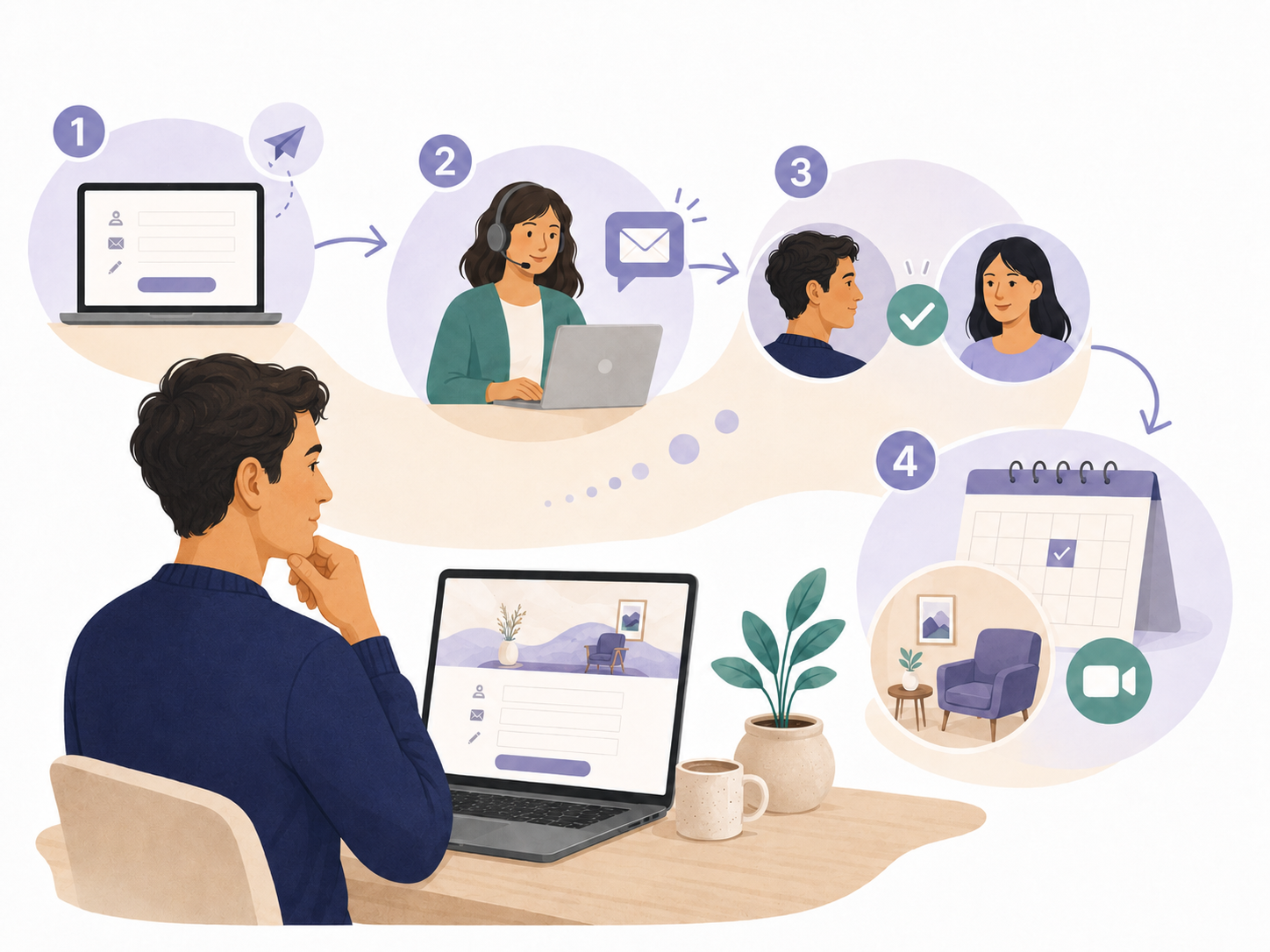
Your contact page is not just a place to list your phone number. It is often the moment a potential client decides whether reaching out feels simple, safe, and clear.
Have you ever had someone visit your website, click around, maybe even land on your contact page, and then leave without reaching out?
It is easy to assume the problem is the homepage, the service pages, or not enough traffic.
Sometimes that is true.
But sometimes the issue is much closer to the finish line.
The person was almost ready. They wanted to know what to do next. Then the contact page made the next step feel uncertain.
A strong contact page does more than collect messages. It helps a potential client understand what happens next.
The missed website moment
Why the contact page matters
By the time someone reaches your contact page, they may already be interested.
They have likely done some quiet work before they got there.
They may have read about your services. They may have looked at clinician bios. They may have checked whether your practice works with their concern, their schedule, their insurance, or their location.
For many people, especially people looking for therapy, reaching out is not a casual action.
They may be nervous. They may be overwhelmed. They may be comparing several practices. They may be helping a partner, child, parent, or friend find care. They may not know exactly what to ask.
So the contact page has an important job.
It should make the next step feel easier.
The contact page is often the bridge between interest and inquiry.
When that bridge feels unclear, people may pause. And when people pause, they may leave.
The common problem
Why a form is not enough
A contact form can collect information, but it does not always answer the questions people have before they use it.
Many contact pages are very thin.
They include a form, a phone number, an email address, and maybe an office location.
That may seem practical from inside the practice. The team knows what happens after someone reaches out. The owner knows who checks the form. The intake coordinator knows when calls are returned. The clinicians know who is accepting clients.
But website visitors do not know any of that.
They may be wondering:
- Will someone actually respond?
- How long does it usually take?
- Can I ask about fit before scheduling?
- Do I need to be ready to book right away?
- What information should I include?
- What happens if you are not the right fit?
- Is this the right place to ask about fees, insurance, or availability?
If those questions are not answered, the contact page may create more uncertainty than confidence.
What visitors are looking for
What people need before they reach out
A good contact page gives people enough information to take the next step without overexplaining everything.
This does not mean turning the page into a long intake manual.
It means answering the few questions that commonly stop people from reaching out.
Most potential clients do not need every detail yet. They need orientation.
They need to know they are in the right place, what action to take, and what will happen after they take it.
| What they may wonder | What the page can clarify |
|---|---|
| “Is this the right practice for me?” | Briefly name who the practice serves and what concerns you commonly support. |
| “What should I do first?” | Make one primary next step obvious. |
| “What happens after I submit the form?” | Explain the response window and next step. |
| “Can I ask about fees or availability?” | Invite practical questions without making the visitor search for answers. |
| “What if this is urgent?” | Include a clear crisis note when appropriate. |
The goal is not to convince someone. The goal is to reduce confusion.
The practical fix
Make the next step clear
Choose one primary action you want the visitor to take.
A common contact page problem is offering too many equal options.
Call us. Email us. Fill out this form. Book online. Request a consultation. Fax us. Message us through a portal. Choose a clinician. Ask a question.
Each option may make sense internally.
But to a person who is already unsure, too many choices can create hesitation.
Choose the main action you want most new inquiries to take. Then make that action the clearest part of the page.
Simple page language
“The easiest way to get started is to complete the form below. Our intake team will review your message and respond within one business day with the next step.”
That kind of sentence does a lot of quiet work.
It tells the visitor what to do. It tells them who will see the message. It gives them a response expectation. It lowers the fear that their message will disappear.
Simple language can make the page feel more human.
Small details matter
Reduce small moments of uncertainty
People often leave because of small unanswered questions, not because the whole website is wrong.
Contact pages can accidentally create friction in small ways.
A form asks for too much information. A phone number appears without office hours. An email address appears without saying whether email is secure. A button says “Submit” but does not say what happens after. A page says “Contact us” but does not explain whether the practice is taking new clients.
None of these issues may feel major on their own.
Together, they can make reaching out feel harder than it needs to be.
- Add one sentence explaining what happens after someone submits the form.
- State your typical response window during business hours.
- Clarify whether the form is for new client inquiries, referral questions, or both.
- Make the main call-to-action button more specific than “Submit.”
- Add a short note for urgent or crisis situations, if appropriate for your practice.
These are small edits, but they can make the page feel more trustworthy and easier to use.
A practice example
What this can look like in real life
A contact page does not need to be long to be useful.
Imagine a group therapy practice with a contact page that only says:
“Contact us today.”
Then there is a form with name, email, phone number, and message.
The page is short. It is clean. It works technically.
But it leaves a lot unsaid.
Now imagine the same page with a few simple additions:
“Looking for therapy for yourself, your child, or your relationship? Complete the form below and our intake coordinator will review your message.”
“We usually respond within one business day. If we may be a fit, we will help you understand availability, fees, and the next step for scheduling.”
“If this is an emergency or you need immediate support, please call 988 or go to your nearest emergency room.”
That version does not pressure anyone.
It simply gives the visitor a clearer path.
Quick check
Look at your contact page like a first-time visitor
Open your contact page and answer these questions without using what you already know about your practice.
Is the main next step obvious within a few seconds?
Does the page explain what happens after someone reaches out?
Does the page give a realistic response-time expectation?
Does the page help people ask about fit, fees, availability, or next steps?
Does the page make clear what to do in an urgent or crisis situation?
If you answered no to two or more, your contact page may be adding friction at the exact moment someone is close to reaching out.
That does not mean the page is broken.
It means one small improvement may make the path easier.
Free resources
Two quick tools to check your website path
Before rewriting the whole contact page, use one simple tool to see where visitors may be hesitating.
These free resources are most useful if your website already gets some attention, but visitors are not consistently turning into new client inquiries.
Free website scan
Therapy Practice Website Scanner
Use this to check whether your website makes it easier for right-fit clients to understand who you help, how intake works, and what to do next.
Free visibility scan
Therapy Practice Local SEO Mini-Report
Use this to review local visibility, service-page clarity, intake friction, and practical next steps for helping right-fit clients find and understand your practice.
You do not need to use both tools at once. Start with the website scanner if the contact page, service pages, or next step feel unclear. Use the local visibility scan if people may not be finding the practice clearly in the first place.
The bigger path
Your contact page is part of the intake process
Your contact page should not be treated as only a form, phone number, or email address.
It is part of the intake experience.
Before someone ever speaks with your team, the contact page may shape how they feel about reaching out.
If it is vague, they may wonder whether their message will be answered. If it is cold, they may feel like they are submitting information into a blank box. If it is cluttered, they may not know which option to choose.
A stronger contact page helps the visitor understand three simple things:
- What to do next.
- What happens after they do it.
- What they can expect from your team.
Your contact page is one piece of the larger website path. If people arrive there still unsure about fit, fees, availability, or what happens next, the earlier pages may need attention too. Read Therapy website strategy: why visitors do not become inquiries to walk through the full path from visitor confusion to a clearer next step.
Try checking this once this week.
Read your contact page out loud and ask: “Would a person who is tired, anxious, busy, or unsure know exactly what to do next?”
If the answer is no, start with one sentence.
Explain what happens after someone reaches out.
That one sentence can make the next step feel easier, clearer, and more human.
Want help seeing where website visitors may be getting stuck? A simple outside look at your website path can make the next improvement easier to choose.
Related Reading
If your contact page collects information but does not reduce uncertainty, read these next:
