Are you getting inquiries from the wrong people?
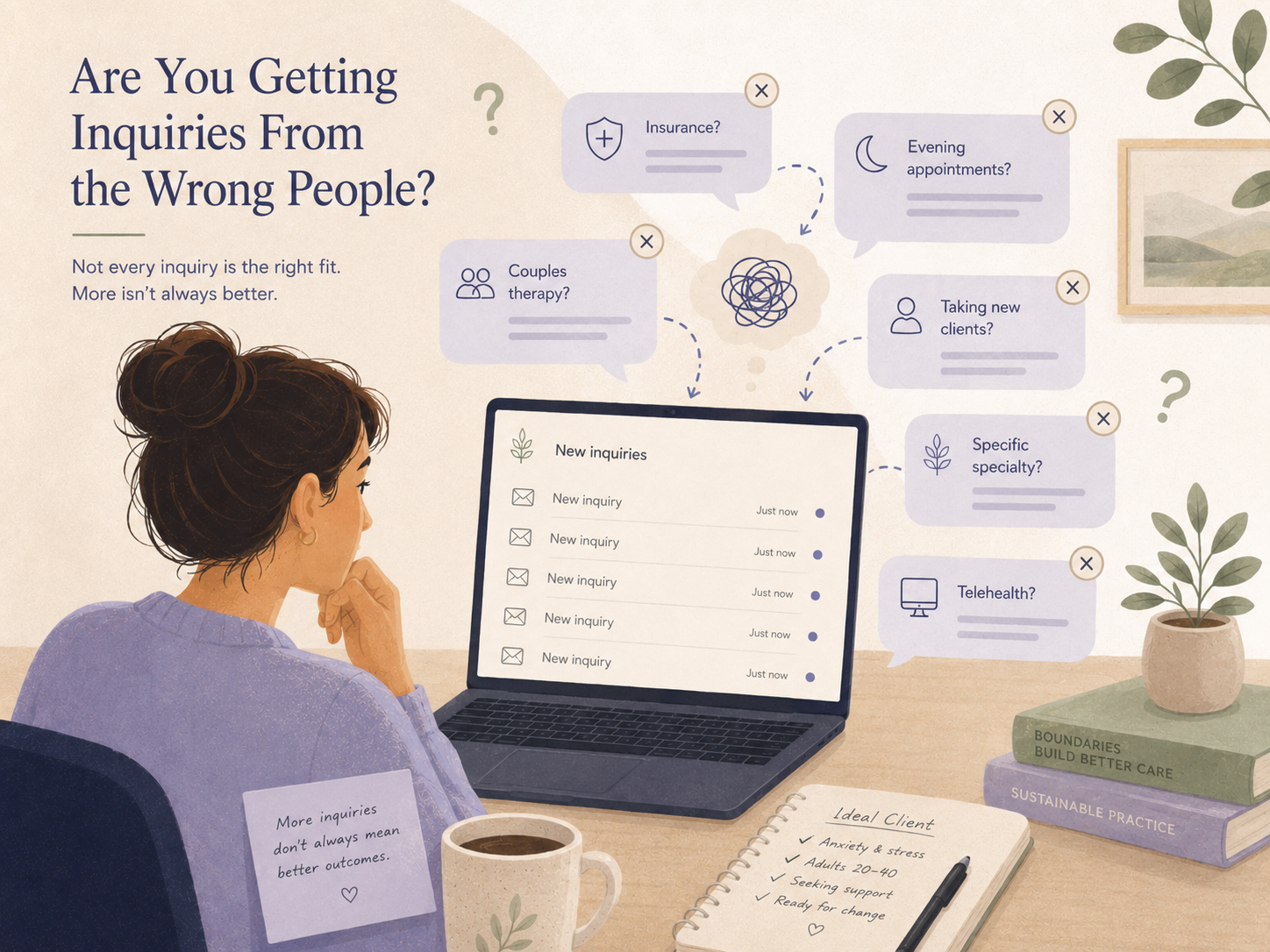
More inquiries are not always better if many of them are poor fit. Before changing your marketing, look at why unscheduled inquiries are not booking.
Are new client inquiries coming in, but too many of them are not turning into scheduled appointments?
This can be confusing for a practice owner.
On paper, it looks like visibility is working. People are finding the practice. They are filling out the form. They are calling. They are asking questions.
But then the process stalls.
The better first question is not, “How do we get more inquiries?” It is, “Why are some of the inquiries we already get not booking?”
The hidden issue
When inquiries are not the right fit
Your practice may be getting inquiries. They just may not be the right inquiries.
Someone asks if you take an insurance plan you do not accept. Someone needs evening appointments, but the only openings are during the day. Someone wants a service you no longer offer. Someone needs a higher level of care. Someone reaches out for a clinician type, specialty, or schedule that is not available.
The practice is getting attention.
But the attention is not turning into enough right-fit appointments.
A full inbox can still hide a growth leak if too many inquiries are poor fit.
The common assumption
Why more is not always better
More inquiries are only helpful when the practice can serve the people who are reaching out.
That can feel strange to say, especially when practice owners are often told they need more visibility, more website traffic, more directory views, more social posts, or more referrals.
Sometimes that is true.
But if many of your inquiries are a poor fit, more marketing may simply bring more people into the same confusing process.
This does not mean the people reaching out are wrong. It does not mean your team is doing anything wrong. It does not mean your practice has a bad reputation.
It usually means potential clients are making decisions with unclear information.
- They may not know your fees before they reach out.
- They may not understand whether you accept their insurance.
- They may not realize your current openings are daytime only.
- They may not know which services are available or full.
- They may not know who the practice is best suited to help.
When that information is hard to find, people do what most people do.
They ask.
That creates more work for the intake team. It also creates more emotional weight for the owner, especially when the team has to say no, redirect someone, or explain cost and availability again and again.
The practical tip
The two-week inquiry tracker
For the next two weeks, track why unscheduled inquiries did not book.
Do not start with a full marketing review. Do not rebuild your website. Do not rewrite every service page yet. Do not assume the problem is your fee, your directory profile, your admin team, or your visibility.
Start with one small tracking habit.
For every new client inquiry that does not schedule, write down the main reason. Keep it simple. You can use a spreadsheet, a note in your intake tracker, or a shared document. Avoid including private clinical details. The goal is to notice patterns, not create a complicated record.
Use simple categories
- Insurance or cost mismatch
- Schedule mismatch
- Service not offered
- Clinician fit not available
- Higher level of care needed
- Location or telehealth mismatch
- No clear next step given
- Person stopped responding
- Unknown
The useful question
After you write down the reason, ask: “Could this person have known this before reaching out?”
That question is where the insight lives.
What to look for
How to read what you find
Once you track unscheduled inquiries for two weeks, look for what repeats.
You are not trying to make every inquiry schedule. You are trying to understand whether the same confusion is happening again and again.
| What you notice | What it may mean |
|---|---|
| Several people ask about insurance you do not accept. | Your fee and insurance explanation may need to be clearer before intake. |
| Several people need evening appointments. | Your availability may need to be clearer, or your marketing may be attracting people with a schedule mismatch. |
| People ask for services you do not offer. | Your website, directory profiles, or referral messaging may be outdated. |
| People disappear after receiving payment information. | Your explanation may be accurate, but too long, too vague, or too hard to act on. |
| You do not know why people did not book. | Your first fix may be tracking, not marketing. |
The goal is to help right-fit clients understand the next step faster, while helping poor-fit clients self-select before they take up intake time.
Example
A practice example
Imagine a group therapy practice that gets 24 inquiries over two weeks.
At first, the owner feels encouraged. The website is being found. The contact form is working. People are reaching out.
But only 10 people schedule.
Instead of assuming the practice needs more marketing, the owner reviews the 14 unscheduled inquiries.
Here is what they find
- Four people wanted to use an insurance plan the practice does not accept.
- Three people needed evening appointments, but the only current openings were weekday mornings.
- Two people were looking for couples therapy, which the practice no longer offers.
- Two people needed support that was outside the practice’s scope.
- One person wanted a clinician with a specific specialty that was not currently available.
- Two people stopped responding after receiving the first reply.
Now the owner has a clearer picture.
This is not simply a “we need more inquiries” problem.
The practice has a clarity problem.
The next step is much smaller than a full marketing overhaul. The owner updates the website and directory profiles to make three things clearer:
- Who the practice is best for right now
- Which payment options are accepted
- Which appointment times are currently easiest to book
The team also creates one short response for poor-fit inquiries, so intake staff do not have to improvise every time.
Nothing about this is flashy. But it gives the practice a cleaner path.
Right-fit clients can move forward with less confusion. Poor-fit inquiries can be redirected more kindly and efficiently. The owner can stop guessing about whether the problem is visibility, pricing, scheduling, or services.
Quick check
Look at your last 10 unscheduled inquiries
What was the most common reason people did not book?
They wanted insurance you do not accept.
They could not afford the fee or were surprised by the cost.
They needed appointment times you do not have.
They wanted a service you do not offer.
They needed a different level of care.
They stopped responding and you are not sure why.
You do not have a clear record of what happened.
If your answer is G, that is the first place to start.
Not because your practice is doing anything wrong.
Because without a simple record, every growth decision becomes harder.
More inquiries are not always better. Better-fit inquiries are more useful. Try tracking this once this week. The pattern may be easier to see than you think.
Want help finding where poor-fit inquiries are coming from? Click here.
Related Reading
If inquiries are coming in but many are not the right fit, these may help:
