Why “we help with anxiety and depression” may not be clear enough
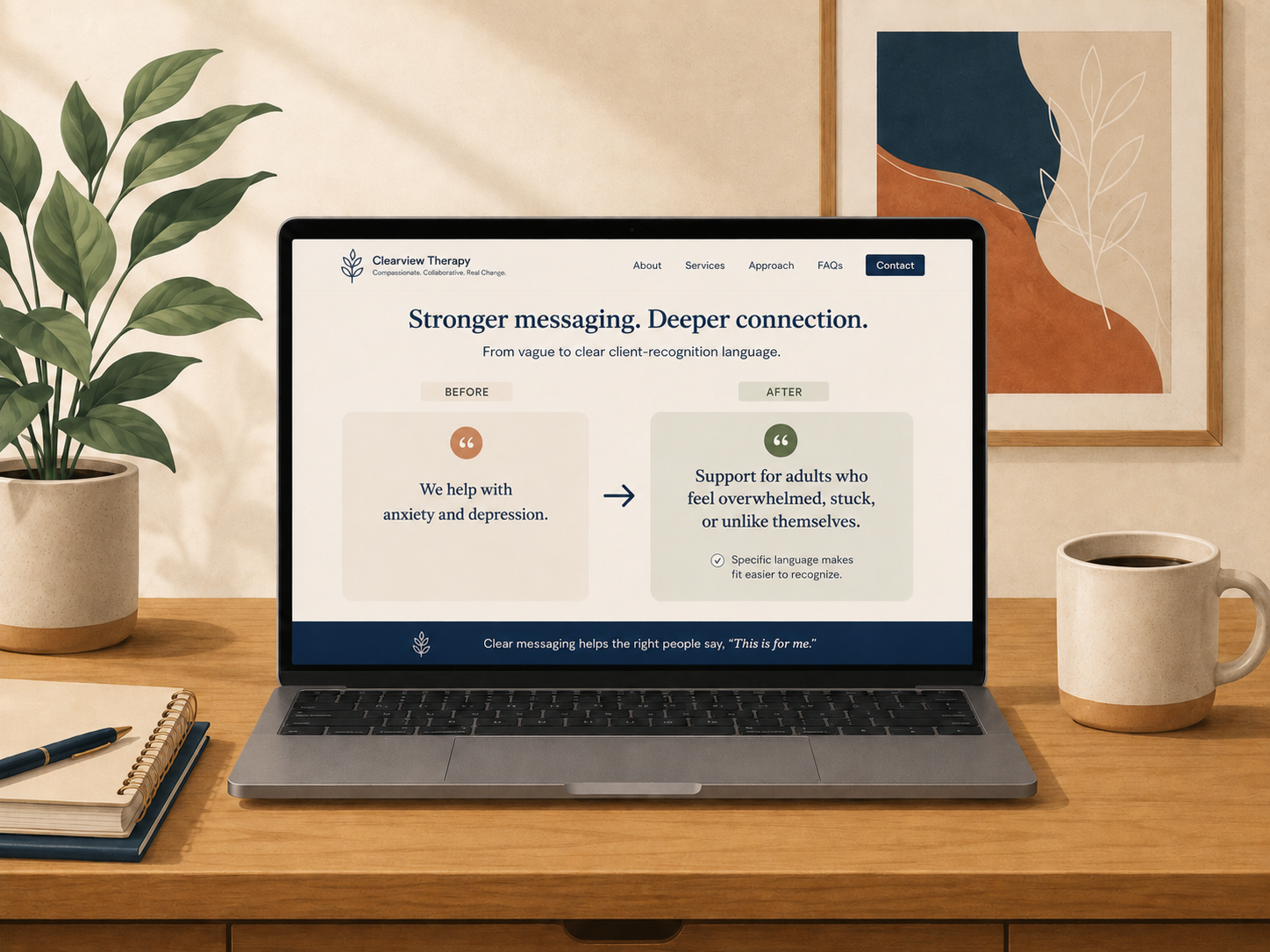
Broad service language can be accurate and still too vague for a potential client to recognize themselves.
Have you ever looked at your therapy website and thought, “This is accurate, but it still feels a little flat”?
Maybe your service page says something like:
“We help adults with anxiety and depression.”
There is nothing wrong with that sentence. It names real concerns. It may match what your clinicians actually treat.
But for a potential client reading your website, it may not be enough.
In 2024, approximately 62 million U.S. adults — 23% of all adults — had a mental illness, and nearly half of them did not receive treatment. HRSA’s 2025 behavioral health workforce brief also notes that the national average wait time for behavioral health services is 48 days.
So when someone finally lands on a therapy practice website, the language should not make them work harder to understand whether the practice can help.
A person looking for support does not always think in neat clinical categories. They may not be saying, “I need anxiety treatment.” They may be thinking, “I cannot turn my brain off at night,” or “I keep snapping at people I love,” or “I am doing everything I’m supposed to do, but I feel empty.”
That gap matters.
A phrase like “we help with anxiety and depression” may be accurate, but it may still be too broad for a potential client to recognize their own experience.
The problem
Broad words make the client do the translating
A potential client is not only asking, “Do you treat anxiety?” They are asking, “Do you understand what this feels like in my life?”
Broad service language is common on therapy websites.
You see it everywhere:
Anxiety. Depression. Trauma. Relationships. Life transitions. Stress.
These words are not bad. They help organize services. They can help with search. They can help referral partners quickly understand what you offer.
If you are also working on search visibility, this is where service-page clarity connects to local SEO. For a fuller plain-English walkthrough, read Local SEO for therapists: how to show up for right-fit local searches.
The problem is that broad words do not always help a website visitor answer the question they are really asking:
“Is this for me?”
A potential client may not know whether their anxiety “counts.” They may not know whether their low mood is what you mean by depression. They may wonder whether they need to be in crisis to reach out. They may worry their situation is too mild, too complicated, too messy, or too hard to explain.
When your service page stays too general, the visitor has to do too much work.
They have to translate your words into their life.
That is where many good-fit clients hesitate.
Not because your practice is not a fit.
Not because your clinicians are not skilled.
Not because the website looks unprofessional.
Because the language does not help them recognize themselves quickly enough.
Why this happens
Most practice owners were not trained to write service pages
You were trained to listen carefully, assess thoughtfully, maintain boundaries, protect privacy, and provide good care.
You were not necessarily trained to turn clinical services into plain-language website pages.
So it makes sense that many practice websites default to broad, safe language.
Broad language can feel less risky. It feels inclusive. It feels professional. It avoids sounding too salesy.
But there is a tradeoff.
When the language is too broad, it can become hard to tell one practice from another.
A visitor may see five local practices that all say they help with anxiety and depression. If every page sounds similar, they may choose based on availability, insurance, price, location, or whichever practice gives them the clearest next step.
Your website does not need to sound flashy.
It does need to be useful.
The tip
Rewrite one broad phrase into one client-recognition sentence
Do not rewrite your whole website this week. Pick one phrase and make it easier to recognize.
For example:
“We help with anxiety and depression.”
Then add one sentence underneath it that describes what this might look like in real life.
Simple format:
“We often support people who are experiencing [plain-language examples], especially when [common life context].”
That sentence helps the visitor connect the service name to their own experience.
Before
“We provide anxiety therapy.”
After
“We often support adults whose anxiety shows up as constant overthinking, trouble sleeping, people-pleasing, irritability, or feeling unable to relax even when nothing is technically wrong.”
Before
“We help with depression.”
After
“We often support people who feel low, disconnected, unmotivated, or like they are going through the motions, even if they are still keeping up with work, parenting, school, or daily responsibilities.”
Before
“We help teens with anxiety and depression.”
After
“We support teens who seem overwhelmed, withdrawn, tearful, shut down, easily frustrated, or stuck in patterns that are starting to affect school, friendships, sleep, or family life.”
These sentences do not promise an outcome.
They do not diagnose the visitor.
They do not say every person with those experiences is the same.
They simply help someone understand, “This practice may understand what I’m dealing with.”
The useful distinction
Clearer language does not have to exclude people
Practice owners sometimes worry that clearer language will exclude people.
That concern makes sense.
But clarity is not the same as turning people away.
You are not saying, “We only help people with this exact situation.”
You are giving examples.
Examples make broad service language easier to understand.
Your website can help someone recognize possible fit before they ever contact intake.
Think of it like intake.
If someone calls and says, “I think I need help with anxiety,” your intake team may ask a few gentle questions. What has been going on? How is it affecting your life? What kind of support are you hoping for?
Your website can do a small version of that before the person reaches out.
It can name a few real-life patterns that fit your practice’s actual work.
The key is to stay honest.
Use language that matches your services, scope, training, clinicians, and client population. If your practice does not work with crisis-level needs, do not imply that you do. If you only serve adults, do not use examples that sound like child or teen services. If a concern requires a higher level of care, make your service limits clear elsewhere on the page.
Specific language should make fit clearer, not stretch what your practice offers.
Example
What this could look like on a practice website
Imagine a group practice has a service page called “Anxiety and Depression Therapy.”
Original version
“Our therapists help clients manage anxiety and depression using evidence-based approaches in a warm, supportive environment. Contact us today to get started.”
This is not wrong.
But it sounds like many other therapy websites.
Clearer version
“Anxiety and depression do not always look dramatic from the outside. You may still be working, caring for your family, answering emails, and showing up for other people — while feeling tense, disconnected, exhausted, or unlike yourself inside.”
“Our therapists support adults who are dealing with overthinking, low motivation, irritability, sleep changes, people-pleasing, withdrawal, or the feeling that daily life has become harder to manage.”
That version gives the visitor more to hold onto.
It helps them recognize possible fit.
It also gives the intake team and referral partners clearer language to use when describing the service.
That is the real goal.
Not prettier words.
Clearer recognition.
Quick check
Look at one service page this week
Find one broad phrase and ask whether a potential client would know what it looks like in real life.
Choose one phrase, such as “anxiety and depression,” “life transitions,” “stress management,” “relationship issues,” or “trauma.”
Ask: “Would a potential client know what this looks like in real life?”
Add one sentence that starts with: “This may look like…”
Use plain-language examples that match your actual services, scope, and client population.
Read it out loud and ask: “Would a real person understand this?”
For example:
“This may look like replaying conversations, feeling on edge, losing motivation, pulling away from people, struggling to sleep, or feeling like simple tasks take more effort than they used to.”
If it sounds clear, honest, and easy to understand, you have made the page more useful.
You do not need to make your therapy website dramatic to make it clearer.
You do not need to turn every service into a narrow niche.
Start with one broad phrase.
Add one sentence that helps the right person recognize their real-life experience.
Free resources
Want to check the page before rewriting everything?
Use one free tool to spot where clarity may be breaking down before you spend time changing the whole website.
If this article made you wonder whether your service pages are clear enough, start with one of these simple checks.
Free website scan
Therapy Practice Website Scanner
Check whether your website makes it easier for right-fit clients to understand who you help, how intake works, and what to do next.
Free visibility scan
Therapy Search Demand Scanner
Review local visibility, service page clarity, intake friction, and practical next steps for helping right-fit clients find and understand your practice.
A clearer service page helps website visitors understand whether your practice may be a good fit before they ever reach out.
Related Reading
If your service pages feel accurate but still too broad, these may help:
