The search moment before a therapy client is ready to book
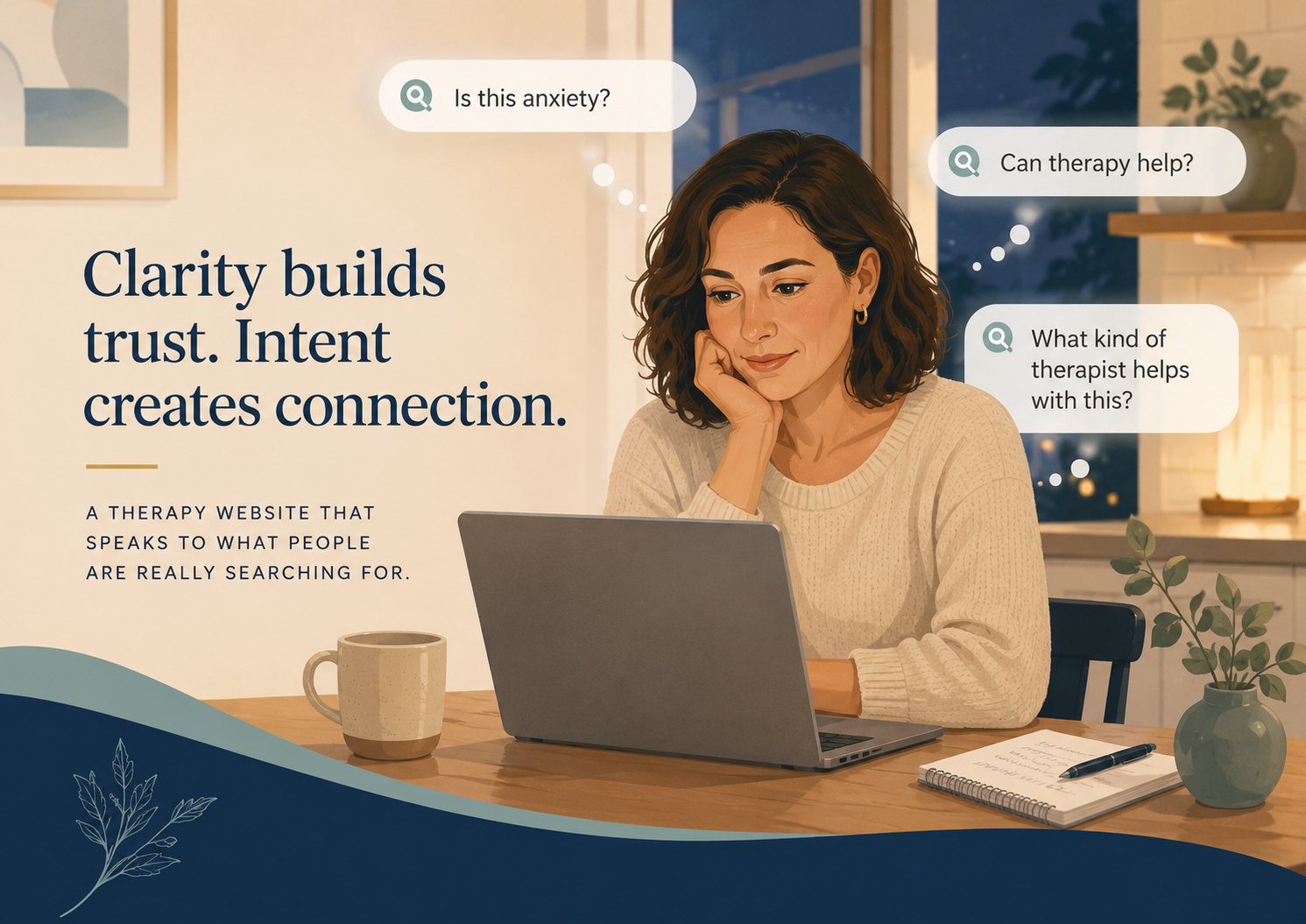
Before someone is ready to book, they may need help understanding whether your service fits what they are experiencing.
Have you ever looked at one of your service pages and thought, “This explains what we offer. Why are people still leaving without reaching out?”
The page may be accurate. It may list the service, the population, the approach, the fee, and the contact button.
But it may still skip the moment many people are in.
They are not yet asking, “Which therapist should I choose?”
They are asking something earlier.
The search moment between “What is this?” and “Can someone help?” is where clear service-page language can make the next step feel easier.
Why this matters
Many visitors are still trying to understand their own situation.
They may be asking:
“Is this what I’m dealing with?”
“Is therapy for this?”
“What kind of help would make sense?”
“Is this bad enough to reach out?”
“Can someone help with this, or do I just need to handle it?”
That does not mean a clearer service page solves access barriers. It does not. Cost, availability, insurance, stigma, and fit all matter.
But clear language can reduce one smaller barrier: confusion.
When someone lands on your page, they may not know the clinical term for what they are experiencing. They may not know whether they need anxiety therapy, trauma therapy, couples therapy, parent coaching, testing, medication support, or something else entirely.
So if your page only says what you provide, without explaining what it helps with in everyday life, the visitor may leave still unsure.
This is part of the larger job of a therapy website: helping visitors understand fit, next steps, and whether reaching out feels manageable. For a broader review of that decision path, read Therapy website strategy: why visitors do not become inquiries.
The problem
Your page may be written for someone who is already ready to choose.
Many practice websites are written for people who are already ready to choose a provider.
Those pages often answer questions like:
Who is on the team?
What services do we offer?
How do I schedule?
Do we take insurance?
Where are we located?
Those are useful questions.
But interest-stage visitors are often asking a different kind of question. They are trying to understand their own situation.
| What they may search | What they may really need |
|---|---|
| Does therapy help with overthinking? | A plain-language bridge from their daily experience to the service you offer. |
| What kind of therapist helps with panic attacks? | A simple explanation of what support may look like and when to reach out. |
| When should couples try therapy? | Reassurance that they do not need to wait until things are at a breaking point. |
| Is trauma therapy only for PTSD? | Clear, careful language that explains fit without overpromising. |
A practice owner may think, “We already have an anxiety therapy page.”
But the visitor may not be thinking, “I need anxiety therapy.”
They may be thinking, “I can’t sleep because my mind won’t stop. Is this anxiety? Is this stress? Is this something therapy helps with?”
That gap is where many service pages lose people.
Not because the practice is doing anything wrong. Usually, the practice is using professional language that makes sense to other professionals.
But clients often need a simple bridge from their lived experience to your service.
If you are also working on local visibility, this is where service-page language connects to search. The same plain-language phrases that help a visitor understand your page can also help Google and potential clients understand what the page is about. For more on that side of visibility, read Local SEO for therapists: how to show up for right-fit local searches.
The tip
Add one short FAQ to one service page this week.
Use this question: “How do I know if this kind of support might help?”
That’s it.
Not a full page rewrite. Not a new blog series. Not a full search strategy.
Just one helpful FAQ on one service page.
The answer should do three things:
First, name the everyday situations that might bring someone to that service.
Second, explain what the service is meant to support in plain language.
Third, give a calm next step without promising a specific outcome.
Here is a simple structure you can use:
How do I know if this kind of support might help?
This kind of support may be worth considering if you are noticing [everyday signs, situations, or concerns]. You do not need to have everything figured out before reaching out. A first conversation can help you ask questions, share what has been going on, and understand whether this service may be a good fit.
That small FAQ does more than answer a question.
It helps the visitor recognize themselves. It gives them permission not to know the exact label. It makes the service feel easier to understand.
And it creates a clearer next step for someone who is interested but unsure.
Example
Here is what this could look like on an anxiety therapy page.
Let’s say your practice has an anxiety therapy page.
A common version might say:
“We provide evidence-based therapy for anxiety disorders, including generalized anxiety, panic disorder, social anxiety, and phobias.”
That is accurate. But for many visitors, it may still feel too clinical.
They may not know whether what they are experiencing counts as anxiety.
Here is a more helpful FAQ:
How do I know if anxiety therapy might help?
Anxiety therapy may be worth considering if your mind feels hard to turn off, you often prepare for worst-case scenarios, you avoid things because they feel too overwhelming, or your body feels tense even when nothing urgent is happening. You do not need to know whether your experience “counts” as anxiety before reaching out. A first conversation can help you talk through what has been going on and whether this kind of support may be a fit.
Notice what this does.
It does not diagnose the visitor.
It does not promise that therapy will fix the issue.
It does not pressure them to book.
It simply translates the service into the kinds of words a person might actually use when they are worried, tired, or unsure.
You could adapt the same FAQ for other pages.
For couples therapy:
Couples therapy may be worth considering if you keep having the same conversation without getting anywhere, feel more like roommates than partners, avoid certain topics because they turn into conflict, or want help repairing trust after a difficult season. You do not need to be at a breaking point before reaching out. A first conversation can help you understand whether couples therapy may be a good fit for what you are facing.
For teen therapy:
Teen therapy may be worth considering if your teen seems more withdrawn, overwhelmed, irritable, anxious, or unlike themselves, and you are not sure how to support them. You do not need to know exactly what is wrong before asking questions. A first conversation can help you understand what kind of support may make sense.
Each version gives the visitor a little more language for their own concern.
That is often what they need before they can take the next step.
Quick check
Would a visitor understand when this service might be relevant?
Pick one service page on your website.
Read it from the point of view of someone who does not know therapy language.
Would a visitor understand when this service might be relevant to their real-life situation?
Look for places where the page uses words that may be clear to clinicians but vague to clients.
“Anxiety treatment” may be clear to you.
But a visitor may be thinking, “I can’t turn my brain off at night.”
“Couples therapy” may be clear to you.
But a visitor may be thinking, “We keep having the same fight and nothing changes.”
“Teen therapy” may be clear to you.
But a parent may be thinking, “My child seems overwhelmed, but I don’t know if this is serious.”
You do not need to rewrite the whole page.
Start by adding one FAQ:
“How do I know if this kind of support might help?”
Then answer in the words a client might use with a friend.
Not “presenting concerns.”
Not “symptomology.”
Not “evidence-based intervention.”
Not “maladaptive patterns.”
Use real-life language.
“I can’t turn my brain off.”
“We keep having the same fight.”
“My child seems overwhelmed.”
“I don’t feel like myself.”
“I’m functioning, but barely.”
“I know something needs to change, but I don’t know where to start.”
This quick check can help you spot the gap between the service you offer and the words your potential clients may actually be using.
Free resources
Two free tools can help you find better client language.
You do not need expensive software to make this small improvement.
Start with one free resource and look for the words people already use when they are trying to understand the kind of help you offer.
Google Search Console: Use this to see which search terms are already bringing people to your website. Look for question-style phrases, local phrases, and everyday words that could become a helpful FAQ.
Google Business Profile: Use this to check whether your practice name, services, location, hours, photos, and contact details are clear for local visitors who may be comparing options.
Pick one phrase you find and ask, “Would someone who searched this feel understood when they land on our page?”
That one question can help you decide which FAQ to add first.
Closing
Clear language helps people decide whether the next step is worth exploring.
This is not about making your website less professional.
It is about making your professional help easier to understand.
A clearer service page does not push someone to book. It helps them decide whether the next step is worth exploring.
Try adding this FAQ to one page this week. The right-fit client may not be looking for a perfect explanation. They may just need a sentence that helps them think, “That sounds like what I’m dealing with.”
Want to find where your service pages may be creating hesitation? Start by looking for the questions your visitors need answered before they are ready to compare providers.
Related Reading
If visitors may need help understanding whether your service fits their situation, read these next:
