The four search stages your practice website might be missing
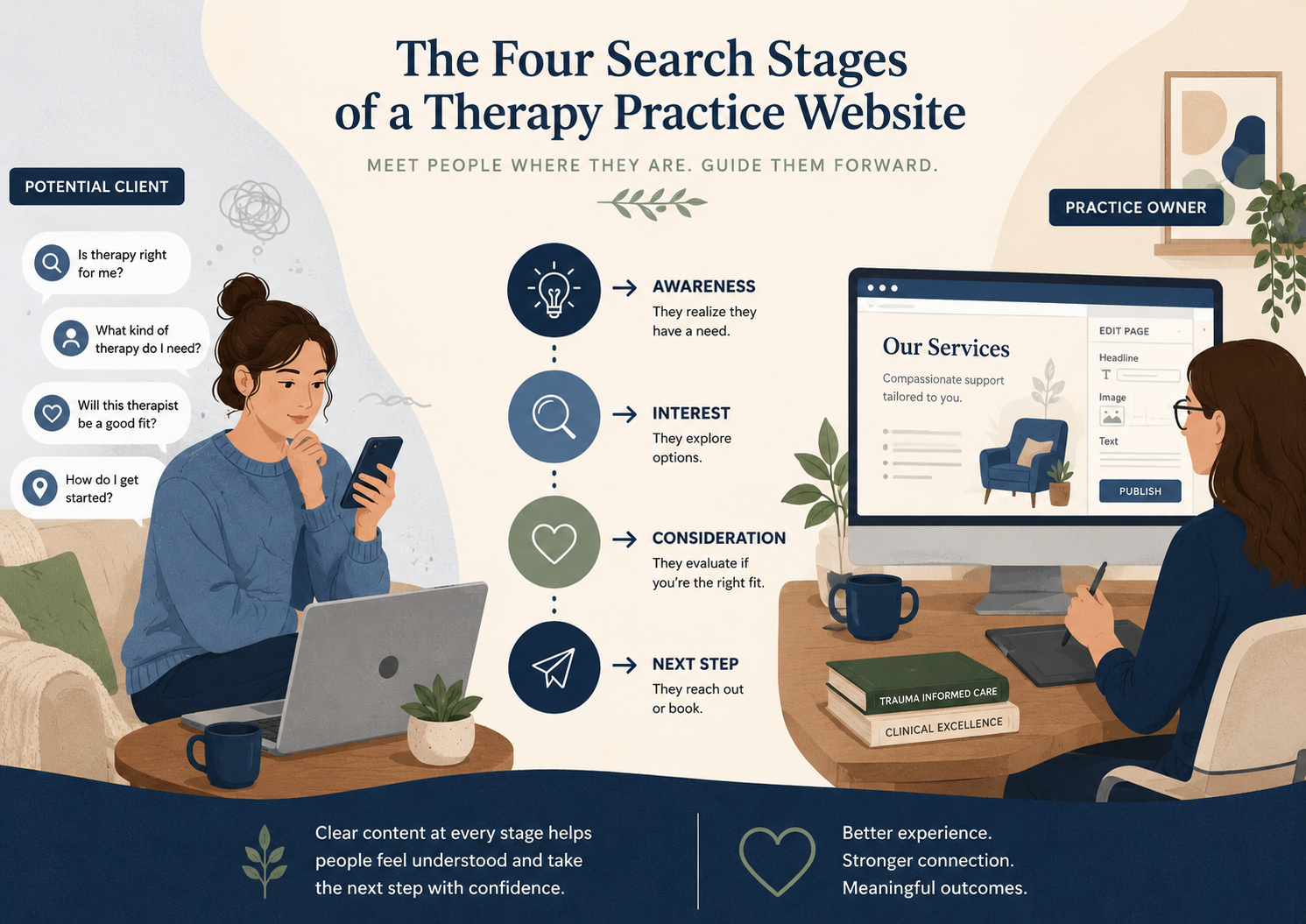
Most practice websites are written for the person who is ready to book. But many potential clients arrive much earlier than that.
Do most people arrive on your practice website already ready to book?
Some do.
They search for something like “anxiety therapist near me,” click your website, look for availability, and contact the practice.
But many people do not start there.
They may start with a quieter search.
“Why do I feel anxious at night?”
“How do I know if my teen needs therapy?”
“Is couples therapy worth it if only one of us wants to go?”
“What kind of therapist helps with trauma?”
That person may not be ready to fill out your intake form yet. They may still be trying to understand what is happening, what kind of help exists, and whether your practice feels like a safe next step.
That matters because the need for care is high, but the path to care is not always simple. In 2024, approximately 62 million U.S. adults had a mental illness, and nearly half did not receive treatment. The same HRSA report notes that the national average wait time for behavioral health services is 48 days.
And in broader healthcare, 89% of consumers say up-to-date online information influences their choice of provider.
Your website is not just a digital brochure. It is often part of how someone decides whether help feels possible.
The problem
Many service pages only help one kind of visitor
Many practice websites are built for only one type of visitor: the person who is ready to reach out right now.
That person needs a clear button. They need to know how to schedule. They need fees, insurance, availability, location, and what happens after they submit the form.
Those details matter.
But they are only one part of the search process.
A potential client may visit your website earlier, before they have the language for what they need. They may not know whether their concern “counts.” They may not know what type of therapy to look for. They may be comparing different practices, different services, or different clinician bios.
If your page only says, “We provide evidence-based therapy for anxiety, depression, trauma, and life transitions,” it may be accurate.
But it may not help the person who is still asking, “Is this what I am dealing with?” or “Would this practice understand me?”
Plain English definition
Search intent simply means: what is this person trying to figure out when they search?
You do not need a complicated marketing system to use this idea. You only need to notice that people arrive with different levels of readiness.
The practical tip
Audit one service page against four search stages
Pick one service page and map it against awareness, interest, consideration, and conversion.
Conversion is just a business word for “the moment someone is ready to act.” For a therapy practice, that may mean calling, submitting a form, requesting a consult, or booking an intake.
The goal is not to turn your website into a pushy sales page.
The goal is to make sure your service page helps people move from confusion to clarity.
Start with one page. Not your whole website. Not every service. Not every clinician bio.
Choose one important service page, such as anxiety therapy, couples therapy, trauma therapy, teen therapy, EMDR, medication management, or postpartum therapy.
Then ask: does this page support all four stages?
The framework
What each search stage needs
1. Awareness
The person is trying to name the problem. Use plain client language that describes what the issue may feel like in daily life.
2. Interest
The person is wondering whether therapy could help. Explain who the service is for and what people commonly want support with.
3. Consideration
The person is comparing options. Give practical details about fit, clinicians, approach, insurance, location, telehealth, and availability.
4. Conversion
The person is ready for a next step. Explain exactly what happens after they call, submit a form, or request a consult.
At the awareness stage, the visitor may not be searching for therapy yet. They may be searching for symptoms, stressors, or real-life situations.
Instead of starting with “We treat generalized anxiety disorder,” you might write:
“You may be overthinking every conversation, feeling tense even when nothing is wrong, or lying awake at night replaying the day.”
That kind of language helps the person recognize themselves.
At the interest stage, explain who the service may be for:
“Anxiety therapy may be a fit if worry is affecting your sleep, relationships, work, school, parenting, or ability to feel present.”
At the consideration stage, add details that help someone compare options without guessing.
“Our anxiety therapy team works with adults, teens, and college students. Some clinicians offer CBT-based support, while others integrate mindfulness, trauma-informed care, or relational approaches. During intake, we help match you with a clinician based on your needs, schedule, and preferences.”
At the conversion stage, tell people what happens next.
“To get started, fill out the inquiry form. Our intake coordinator will review your information and respond within one business day. If we may be a fit, we will help you schedule a consult or first appointment. If we are not the right fit, we will do our best to point you toward other options.”
That one paragraph can reduce uncertainty. It can also reduce repeated intake questions.
Related guide
If your service pages also need to help nearby clients find you, read Local SEO for therapists: how to show up for right-fit local searches. For the bigger picture behind website clarity, read Therapy website strategy: why visitors do not become inquiries.
Example
An anxiety therapy page before and after
Imagine your anxiety therapy page currently says:
“We provide compassionate, evidence-based therapy for anxiety disorders. Our clinicians use CBT, mindfulness, and relational approaches to support clients in developing coping skills.”
That is not wrong.
But it mostly speaks to someone who already knows they need anxiety therapy.
A four-stage version might include:
- Awareness: “You may feel like your mind will not turn off. You may replay conversations, worry about things going wrong, or feel tense even when life looks fine from the outside.”
- Interest: “Therapy can give you a place to understand what anxiety is doing in your daily life and learn ways to respond with more support.”
- Consideration: “Our clinicians work with adults and teens experiencing anxiety related to school, work, relationships, parenting, life changes, and past stress. We offer both in-person and telehealth appointments.”
- Conversion: “Start by completing our inquiry form. We will ask a few practical questions so we can match you with the right clinician and let you know the next available options.”
Notice the difference.
The page is still ethical. It is still clear. It does not make clinical promises.
It simply meets the visitor at more than one stage.
Free resources
Two tools to check before rewriting more pages
Once you audit one service page, use one of these free Practice Growth Lab tools to see whether the same clarity problem is showing up elsewhere.
You do not need to fix everything at once. Start by checking the page or visibility gap that is most likely to affect right-fit inquiries.
Local SEO Visibility Scanner
Use this if you are not sure whether your practice is showing up clearly for local searches connected to your services, city, neighborhood, or service area.
Scan my local visibilityPractice Website Scanner
Use this if your website looks polished, but visitors may still struggle to understand who you help, how intake works, or what to do next.
Scan my websitePick one scanner. Look for one weak spot. Then make one small edit before moving on to another page.
Quick check
Which stage is missing from one service page?
Choose one service page this week.
Read it as if you are a potential client who has never been to therapy before.
Then mark which stage is strongest:
- Awareness: Does the page describe the real-life problem in plain language?
- Interest: Does it explain who the service may help?
- Consideration: Does it give enough detail to compare options?
- Conversion: Does it clearly explain the next step?
Now mark which stage is weakest.
That is your edit for the week.
Do not rewrite the whole page. Add one missing paragraph, one clearer section, or one short FAQ.
- If awareness is missing, add client language.
- If interest is missing, explain who the service is for.
- If consideration is missing, add practical fit details.
- If conversion is missing, explain exactly what happens after someone reaches out.
A strong practice website does not only speak to the person who is ready to book today. It also helps the person who is still trying to understand what they need.
Related Reading
If your website mainly speaks to people who are already ready to book, read these next:
