The drop-off number hiding between inquiry and intake
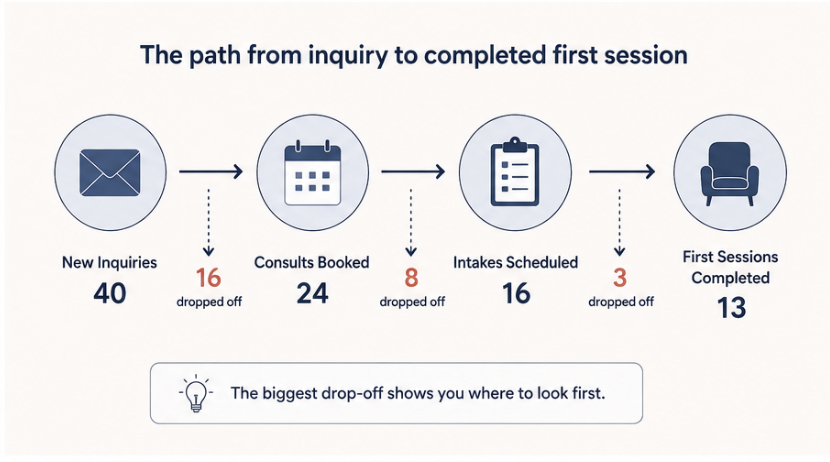
Before you assume your practice needs more inquiries, check how many people are slipping away between inquiry and completed first session.
Have you ever looked at your inquiry numbers and thought, “We should be busier than this”?
The emails are coming in. The phone rings. A few people fill out the website form. Referral partners are still sending names. Maybe your directory profile is getting views.
But the schedule does not reflect that interest.
A clinician still has openings. Revenue feels uneven. Your admin team says people are “not getting back to us.” And the owner starts wondering whether the practice needs more marketing.
Maybe it does.
But maybe the real issue is quieter.
A practice may already have enough interest. The path from inquiry to consult to intake may simply be breaking quietly.
The problem
Inquiry volume is only the first step.
Practice owners often treat inquiry volume as the main sign of growth.
More inquiries feels safer. More visibility feels like progress. More traffic, more posts, more referral outreach, more directory updates.
But inquiry volume is only the first step.
That combination matters. Many practices have openings. Many owners were never taught how to track the business path between “someone reached out” and “someone attended their first appointment.”
If 40 people reach out in a month and only 10 complete a first session, the practice does not just have a visibility question. It has a follow-through question.
Some drop-off is normal.
Not every inquiry is a good fit. Some people need a higher level of care. Some cannot afford the fee. Some need evening times you do not offer. Some are shopping around. Some never intended to schedule.
The goal is not to turn every inquiry into a client.
The goal is to see whether right-fit people are getting stuck because the path is unclear, slow, inconsistent, or hard to complete.
That is a different kind of growth problem.
The tip
Pull the last 30 days and count four numbers.
Do not overbuild this. For one 30-day period, count the path from inquiry to completed first session.
- New inquiries
- Consults booked
- Intakes scheduled
- First sessions completed
Then ask one question:
Where is the biggest drop-off?
That is the number hiding between inquiry and intake.
It shows you where to look before changing your marketing.
You can do this in a spreadsheet, your intake tracker, your EHR reports, your call log, or a simple shared document. Use practice-level information only. You do not need client details to see the pattern.
Example
A simple 30-day example
Imagine a group practice reviews the last 30 days.
Here is what they find:
| Stage | Number | What happened |
|---|---|---|
| New inquiries | 40 | People reached out by phone, website form, directory, and referral. |
| Consults booked | 24 | 16 did not book a consult. |
| Intakes scheduled | 16 | 8 consults did not become scheduled intakes. |
| First sessions completed | 13 | 3 scheduled intakes did not attend the first appointment. |
At first, the owner sees 40 inquiries and feels confused.
Forty sounds like enough interest.
But only 13 people completed a first session.
That means 27 people dropped off somewhere before the practice could start care.
The biggest number lost was between inquiry and consult: 16 people.
Now the owner has a better question.
Not “How do we get more leads?” But “Why are so many people not booking the consult?”
That question points to practical checks: response time, voicemail follow-up, first reply clarity, current openings, fee explanations, consult links, and one simple follow-up if the person does not reply.
None of those require a rebrand.
They require looking at the step where people are slipping away.
How to read it
What the numbers might mean
The drop-off point tells you where to inspect first.
| Largest drop-off | Where to look first |
|---|---|
| Inquiry to consult | Response time, missed calls, vague replies, unclear next steps, or too much friction before scheduling. |
| Consult to scheduled intake | Consult structure, fit explanation, fee clarity, availability match, and whether the person leaves with a clear next step. |
| Scheduled intake to first session completed | Confirmation messages, paperwork friction, reminders, payment setup, cancellation policies, and wait time before the first appointment. |
| Many inquiries are poor fit | Website language, referral partner messaging, directory profiles, service pages, and whether people understand who the practice is best for. |
The point is not to judge the team.
The point is to stop guessing.
Internal checks
Seven checks to run this week
Once you know the largest drop-off, look at the last few people in that stage and check what happened.
- Did the inquiry receive a response within the practice’s stated response window?
- Did the first response clearly offer one next step?
- Did the person know which clinician, service, or appointment type was available?
- Were fees, insurance, and payment basics easy to understand?
- Did anyone follow up once if the person did not reply?
- Did consult calls end with a clear scheduling option or referral recommendation?
- Did someone check on incomplete paperwork before the first appointment?
You may not need all seven.
Choose the checks that match your largest drop-off.
A practice losing people before consults should not spend the week rewriting intake paperwork.
A practice losing people after consults should not start by redesigning the homepage.
The stage tells you where to look.
Free tools
Use the calculators before changing the plan.
If you want a simple way to map the numbers, use the Inquiry-to-Intake Calculator. It helps you enter inquiries, responses, consults, intakes, and first attended sessions so you can see the biggest leak.
If you want to compare intake drop-off against capacity, fees, and growth goals, use the Practice Growth Calculator.
And if this brings up a bigger planning question, the Growth Strategy and Business Planning for Therapy Practices guide can help you see how intake, referrals, website clarity, pricing, and owner time fit together.
The main point is simple.
Before you decide the practice needs more attention, check whether the attention you already have is turning into completed first sessions.
Quick check
Look at your last 30 days of inquiries.
Which statement is closest?
We know how many became consults, scheduled intakes, and completed first sessions.
We know how many scheduled, but not where people dropped off.
We know inquiries came in, but we would have to dig to find outcomes.
We are not tracking this yet.
If your answer is B, C, or D, that does not mean your practice is doing something wrong.
It means your next growth clue may already be sitting inside your inquiry history.
Try checking this once this week. Count the path from inquiry to completed first session. The number may show whether your next fix is more visibility, faster response, clearer follow-up, better consult structure, or a simpler intake handoff.
Small leaks are easier to fix when you can see where they are.
Want to find the biggest leak in your intake path? Start with the Inquiry-to-Intake Calculator and compare the result with your last 30 days of inquiries.
