Google Business Profile categories checklist for therapists
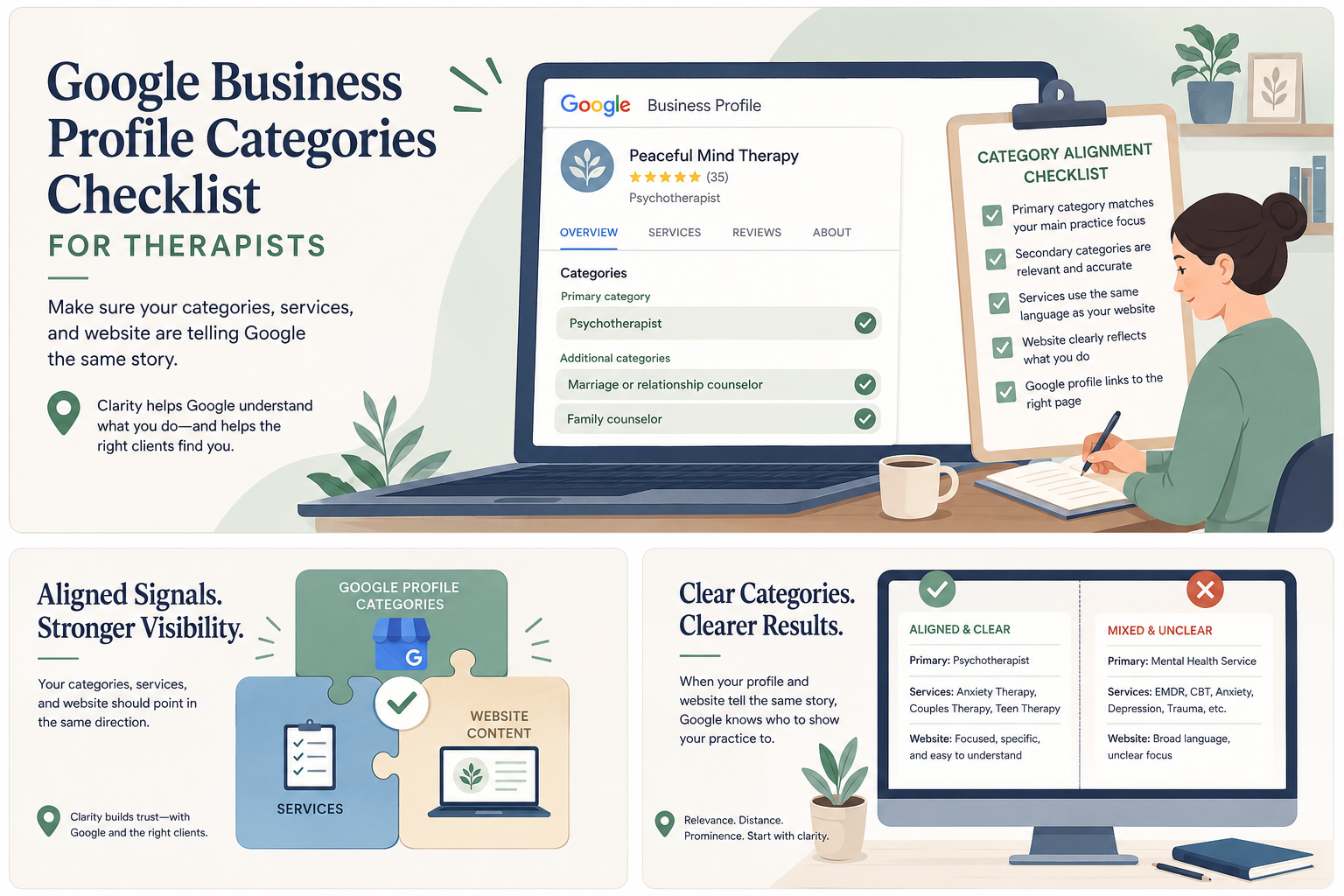
Before you add more services to your Google Business Profile, check whether your categories and website are telling Google the same story.
Have you ever searched for your therapy practice on Google Maps and wondered why a similar practice shows up more clearly?
Maybe their profile looks more specific. Maybe Google seems to understand what they offer. Maybe your practice appears, but not for the searches you care about most.
One small place to check is your Google Business Profile category setup.
It is easy to choose categories quickly when you first create the profile. Many practice owners pick something that sounds close enough, copy a competitor, or add every category that seems even slightly related.
But your categories, services, and website language should point in the same direction.
Your primary category is not a magic switch. But if it does not match what your practice actually does, Google and potential clients may get a mixed message.
Why this matters
Google has to understand what kind of practice you are.
Your Google Business Profile is one of the places where local visibility starts.
One useful data point
BrightLocal reports that 45% of consumers default to Google for local searches, and another 15% default to Google Maps. That does not mean your therapy practice should chase every possible search. It does mean your Google profile should be clear when someone nearby is already looking.
Google says local results are mainly shaped by relevance, distance, and prominence. In plain English, Google is trying to answer: Is this business a good match for what the person searched? Is it near enough? Does it look trustworthy and established?
Your category choices help with the first part: relevance.
If your profile says one thing, your services say another thing, and your website says something broader or more clinical, the whole picture gets fuzzy.
A therapy practice may serve anxiety, trauma, couples, teens, EMDR, testing, and family therapy. That does not mean every one of those things should become a category. Google categories are not the same as a list of specialties.
The goal is not to stuff your profile with every phrase. The goal is to make your main business easy to understand.
The common issue
The profile, services, and website are not always aligned.
Many practice owners choose categories once and never look at them again.
That is understandable. A Google Business Profile has a lot of small settings. Categories can feel like a technical detail.
But over time, the practice changes.
- The practice adds couples therapy.
- A new clinician starts seeing teens.
- The owner wants to grow psychological testing.
- The group moves from general therapy to a few clearer specialties.
- The website gets updated, but the Google profile stays the same.
Now the practice may be sending mixed signals.
The Google profile may look like a general mental health office. The services section may list every modality. The homepage may talk about compassionate care for everyone. The service pages may focus on anxiety, trauma, and couples therapy.
None of those pieces are wrong on their own.
But together, they may not clearly answer one simple question:
What kind of practice is this, and what should Google understand it for?
The practical tip
Run a 15-minute category alignment check.
This week, compare your primary category, secondary categories, services, and website language side by side.
Do not start by changing everything. Start by writing down what is already there.
Write down your primary category.
Does it describe the main type of business you operate, not just one service you wish you had more of?Write down your secondary categories.
Do they describe real parts of the practice, or are they acting like keywords you hope will help?Look at your Google services.
Do your service labels name what people actually look for, such as anxiety therapy, trauma therapy, couples therapy, teen therapy, or psychological testing?Open your homepage on your phone.
Within the first few seconds, can someone tell what kind of practice this is, who you help, and where you serve?Check the page linked from your Google profile.
Does that page support the same story as your primary category and services?
Important
Google does not let you create your own custom category. Choose from the categories available in the Google Business Profile dashboard. If the perfect category is not available, choose the closest accurate category and use your services, description, and website pages to add clarity.
This is not about tricking Google.
It is about reducing confusion.
If your primary category says one thing, your services say another, and your website says something vague, the practice may be harder to understand in local search.
What to look for
Strong, weak, and unclear category alignment
A good category setup usually feels obvious after you see it written out.
| Pattern | What it looks like | What to do next |
|---|---|---|
| Strong alignment | The primary category describes the main practice. Secondary categories are limited and accurate. Google services match the main service pages. The homepage uses similar plain-English language. | Keep the structure. Update services and website wording when the practice changes. |
| Weak alignment | The primary category describes a side service, not the main practice. Secondary categories are used like keywords. The website talks broadly about care but does not support the category choice. | Choose the most accurate main category first. Remove categories that do not describe the practice. Strengthen service labels and page headings. |
| Unclear alignment | The categories are very general, the services are mostly modalities, and the website speaks in clinical or abstract language. A visitor can tell the practice offers therapy, but not what kind of fit it is. | Translate services into client-facing language. Make sure the homepage and key service pages explain the same core focus as the profile. |
A category change alone will not fix a vague website, an incomplete profile, or slow intake follow-up.
But it can help clean up the foundation.
For a broader check, use the Local SEO for Therapists guide and the Google Business Profile for Therapists page to review the rest of the local visibility path.
Example
A practice example
Imagine a group therapy practice that wants more inquiries for couples therapy and teen therapy.
The owner checks the Google Business Profile and finds this:
What the profile says now
- The primary category is broad.
- The secondary categories include several loosely related options.
- The services section lists EMDR, CBT, anxiety, depression, couples, teens, trauma, parenting, and life transitions in no clear order.
- The homepage says, “We provide compassionate support for individuals, couples, and families.”
- The couples therapy page exists, but it is buried in the menu.
The problem is not that the practice is doing anything wrong.
The problem is that the profile and website are making Google and visitors work too hard.
A clearer setup might look like this:
- The primary category describes the main kind of practice as accurately as possible.
- Secondary categories are kept to the few that genuinely describe the practice.
- The services section groups the most important services first.
- The homepage clearly names the main audiences and location.
- The Google profile links to a page that makes the next step easy to understand.
That does not guarantee a ranking change.
But it does make the practice easier to understand.
And in local search, clarity matters.
Quick check
How aligned is your Google profile right now?
Which answer is closest?
The primary category, secondary categories, services, and website all clearly describe the same kind of practice.
The primary category is probably right, but the services or website language need cleanup.
The categories were chosen a long time ago and may not match the current practice.
The profile has many categories because we were hoping more categories would help us show up.
I am not sure what our categories are.
If your answer is C, D, or E, start with the checklist above before changing your website or adding more marketing activity.
Open your Google Business Profile. Write down the category setup. Compare it to your services and homepage. Notice where the story gets fuzzy.
Then fix one alignment issue.
Maybe that means choosing a more accurate primary category. Maybe it means removing a secondary category that does not really describe the practice. Maybe it means rewriting the first section of the homepage so it matches what your profile is saying.
Keep it simple.
Local visibility improves when the practice is easier to understand across Google, your website, and the pages people use before reaching out.
For a practical next step, try the free Local Visibility Scanner. You can also use the Therapy Practice Local SEO Mini-Report if you want to check whether local visibility, service-page clarity, or Google Business Profile gaps may be part of the issue.
Want a clearer read on whether your Google profile and website are telling the same story? Start with one alignment check before changing everything.
